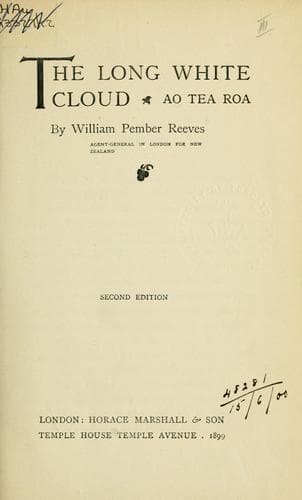
The Long White Cloud: "Ao Tea Roa"Reeves, William Pember
History
The Long White Cloud: "Ao Tea Roa"
Reeves, William Pember
Ethnology -- New Zealand; New Zealand
The laws which regulate retail shops do not aim at securing what is
known as early closing. A weekly half-holiday for all, employer and
employed alike; a fifty-four hours' working week for women and young
persons; seats for shop girls, and liberty to use them; sanitary
inspection of shops. These were the objects of those who framed the
acts, and these have been attained. Under a special section merchants'
offices must close at 5 o'clock p.m. during two-thirds of each month.
On the weekly half-holiday shops in towns must be closed at 1 o'clock,
but each town chooses its own day for closing. Nearly all choose
Wednesday or Thursday, so as not to interfere with the Saturday
market-day of the farmers. Much feeling was stirred up by the passing
of this Act, but it has since entirely died away.
Until 1894 the legal position of Trade Unionists in New Zealand was
much less enviable than that of their brethren in England. The English
Act of 1875 repealing the old Labour Conspiracy law and modifying the
common law doctrine relating thereto, had never been enacted in New
Zealand. The Intimidation law (6 George IV.) was still in force
throughout Australasia; the common law doctrine relating thereto had
not been in any way softened. Within the last few years Australian
Trade Unionists had found the old English law unexpectedly hunted up
for the purpose of putting them into gaol. Three short clauses and a
schedule, passed in 1894, swept from the Statute-Book and the common
law of New Zealand all laws and doctrines specially relating to
conspiracy among members of Trades Unions who in future will only be
amenable to such conspiracy laws as affect all citizens.
In New Zealand most domestic servants and many farm hands and
gardeners are engaged through Servants' Registry Offices. A law,
passed in 1895, provides for the inspection of these, and regulates
the fees charged therein. Office-keepers have to be of good character;
have to register and take out a license; have to keep books and
records which are officially inspected. They are not allowed to keep
lodging-houses or to have any interest in such houses.
Public-domain text, read in full here on John Shaqi.
Reviews
Reviews
No reviews yet
Be the first to share your thoughts on this work.
Elsewhere in the archive
Join the Discussion
Join the discussion
Sign in to leave a comment or review.
Sign InorCreate an account