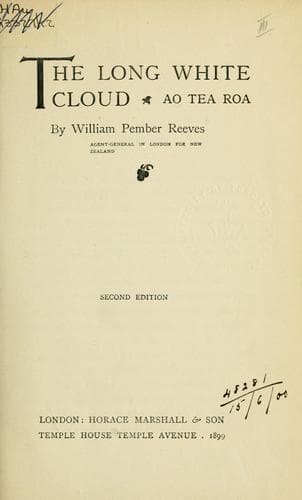
The Long White Cloud: "Ao Tea Roa"Reeves, William Pember
History
The Long White Cloud: "Ao Tea Roa"
Reeves, William Pember
Ethnology -- New Zealand; New Zealand
Those who know anything of politics anywhere, will not need to be told
that the changes and experiments here sketched have been viewed with
suspicion, alarm, contempt, or anger, by a large class of wealthy and
influential New Zealanders. It is but fair that, in a sketch like
this, some emphasis should be laid upon their dissent and protests.
Into the personal attacks of which very much of their criticism
has consisted this is not the place to enter. A summary of the
Conservative view of the progressive work ought, however, to have a
place. Disqualified as I might be thought to be from attempting it, I
prefer to make use of an account written and published in 1896 by an
English barrister, who, in the years 1894-95, spent many months in the
Colony studying with attention its politics and public temper. As his
social acquaintanceships lay chiefly among the Conservatives, he had
no difficulty in getting frank expressions of their views. In the
following sentences he sums up the more moderate and impersonal of
these, as he heard and analysed them:--
"... It must not be supposed that the Conservatives of
New Zealand, any more than those of the mother country, are
apologists for 'sweating.' Indeed, as Mr. Reeves himself has
acknowledged, the labour legislation with which he is associated
was inaugurated by the Government's predecessors, and in carrying
his Bills he had the cordial support of Captain Russell, the
leader of the Opposition. At the same time it is urged that this
protective legislation has been carried to an unreasonable extent,
and people allege, no doubt with a certain amount of exaggeration,
that they feel themselves regulated in all the relations of life. The
measure which has created the most irritation seems to be the
Shop Assistants Act. Employers say that Mr. Reeves has made
every man 'a walking lawsuit,' and that they are chary of having one
about their premises. Moreover, this constant succession of labour
laws, and the language of some of their supporters, have created, so
they say, in the minds of the working classes the impression that the
squatters, manufacturers, and the classes with which they associate,
are tyrants and oppressors, and their lives are embittered by the
feeling that they are regarded as enemies of the people. Further,
they say that the administrative action of the Government tends
to keep up the price of labour, that the price of labour is unreasonably
high, and that this fact, coupled with the necessity of keeping
all the provisions of the labour laws in mind, and the spirit which
they have generated, makes them disinclined to employ labour in
the improvement of their lands. As to the Government's land
policy, while it is admitted that small settlers are desirable, it is
not admitted that large properties are necessarily a curse. What
is resented more fiercely than anything else is the fact that they
Public-domain text, read in full here on John Shaqi.
Reviews
Reviews
No reviews yet
Be the first to share your thoughts on this work.
Elsewhere in the archive
Join the Discussion
Join the discussion
Sign in to leave a comment or review.
Sign InorCreate an account