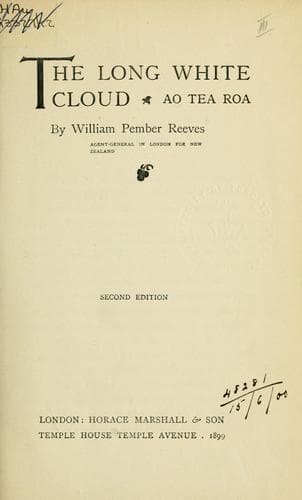
The Long White Cloud: "Ao Tea Roa"Reeves, William Pember
History
The Long White Cloud: "Ao Tea Roa"
Reeves, William Pember
Ethnology -- New Zealand; New Zealand
To sum up the experiments themselves, it may be said that the Colony
has now reached the stage when the State, without being in any way
a monopolist, is a large and active competitor in many fields of
industry. Where it does not compete it often regulates. This very
competition must of course expose it to the most severe tests and
trials. Further progress will chiefly depend on the measure of success
with which it stands these, and on the consequent willingness or
unwillingness of public opinion to make trial of further novelties.
Chapter XXIII
THE NEW ZEALANDERS
"No hungry generations tread thee down."
Some 785,000 whites, browns, and yellows are now living in New
Zealand. Of these the browns are made up of about 37,000 Maoris and
5,800 half-castes. The Maoris seem slowly decreasing, the half-castes
increasing rather rapidly. 315,000 sheep, 30,000 cattle, many horses,
and much land, a little of which they cultivate, some of which they
let, support them comfortably enough. The yellows, some 3,500 Chinese,
are a true alien element. They do not marry--78 European and 14
Chinese wives are all they have, at any rate in the Colony. They are
not met in social intercourse or industrial partnership by any class
of colonists, but work apart as gold-diggers, market-gardeners,
and small shop-keepers, and are the same inscrutable, industrious,
insanitary race of gamblers and opium-smokers in New Zealand as
elsewhere. At one time they were twice as numerous. Then a poll-tax
of £10 was levied on all new-comers. Still, a few score came in every
year, paying the tax, or having it paid for them; and about as many
went home to China, usually with £200 or more about them. In 1895 the
tax was raised to £50, and this seems likely to bring the end quickly.
Despised, disliked, dwindling, the Chinese are bound soon to disappear
from the colony.
Of the 740,000 whites, more than half have been born in the country,
and many are the children, and a few even the grandchildren, of New
Zealand-born parents. An insular race is therefore in process of
forming. What are its characteristics? As the Scotch would say--what
like is it? Does it give any signs of qualities, physical or mental,
tending to distinguish it from Britons, Australians, or North
Americans? The answer is not easy. Nothing is more tempting, and at
the same time more risky, than to thus generalize and speculate too
soon. As was said at the outset, New Zealand has taken an almost
perverse delight in upsetting expectations. Nevertheless, certain
points are worth noting which may, at any rate, help readers to draw
conclusions of their own.
Public-domain text, read in full here on John Shaqi.
Reviews
Reviews
No reviews yet
Be the first to share your thoughts on this work.
Elsewhere in the archive
Join the Discussion
Join the discussion
Sign in to leave a comment or review.
Sign InorCreate an account