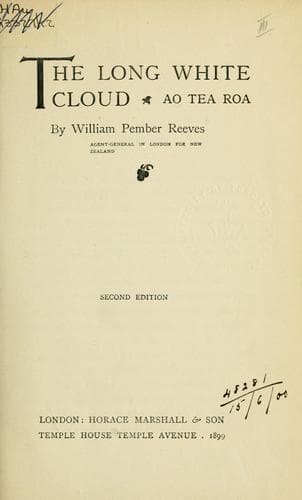
The Long White Cloud: "Ao Tea Roa"Reeves, William Pember
History
The Long White Cloud: "Ao Tea Roa"
Reeves, William Pember
Ethnology -- New Zealand; New Zealand
The Islanders are almost as fond of horses and athletics as their
Australian cousins. They are not nearly such good cricketers, but
play football better, are often good yachtsmen, and hold their own
in rowing, running, jumping, and throwing weights. Fox-hunting is a
forbidden luxury, as the fox may not be imported. But they have some
packs of harriers, and ride to them in a way which would not be
despised in the grass counties at Home. There are fair polo teams too.
They are just as fond of angling and shooting as the race elsewhere.
Capital trout-fishing, some good deer-shooting, and a fine supply of
rabbits, hares, and wild ducks help to console the sportsman for the
scarcity of dangerous game. As might be expected in an educated people
passionately fond of out-door exercises, well fed and clothed, and
with sun and sea air for tonics, drink is not their national vice.
Gambling, especially over horse races, has more claim to that bad
eminence. Perhaps that is one of the reasons why the land rings with
denunciations of drink, while comparatively little has until quite
lately been said against gambling.
Of colonial art there is not much to be said. Sculpture is represented
by an occasional statue brought from England. Architecture in its
higher form is an unknown quantity. Painting is beginning to struggle
towards the light, chiefly in the form of water-colour drawings.
Political satire finds expression in cartoons, for the most part
of that crude sort which depicts public men as horrific ogres and
malformed monsters of appalling disproportions. Music, reading, and
flower gardening are the three chief refining pastimes. The number
and size of the musical societies is worthy of note. So are the
booksellers' shops and free libraries. The books are the same as you
see in London shops. There is no colonial literature. As for flowers,
New Zealanders promise to be as fond of them as the Japanese. There is
a newspaper of some description in the Islands to about every 1,500
adults. Every locality may thus count upon every item of its local
news appearing in print. The Colonists who support this system may be
assumed to get what they want, though, of course, under it quality is
to some extent sacrificed to number. As a class the newspapers are
honest, decent, and energetic as purveyors of news. Every now and then
public opinion declares itself on one side, though the better known
newspapers are on the other. But on the average their influence is not
slight. There is no one leading journal. Of the four or five larger
morning newspapers, the _Otago Daily Times_ shows perhaps the most
practical knowledge of politics and grasp of public business. It is
partisan, but not ferociously so, except in dealing with some pet
aversion, like the present Minister of Lands. You may read in it,
too, now and then, what is a rarity indeed in colonial journalism--a
paragraph written in a spirit of pure, good-natured fun.
Public-domain text, read in full here on John Shaqi.
Reviews
Reviews
No reviews yet
Be the first to share your thoughts on this work.
Elsewhere in the archive
Join the Discussion
Join the discussion
Sign in to leave a comment or review.
Sign InorCreate an account