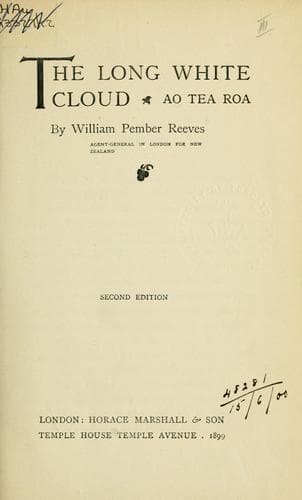
The Long White Cloud: "Ao Tea Roa"Reeves, William Pember
History
The Long White Cloud: "Ao Tea Roa"
Reeves, William Pember
Ethnology -- New Zealand; New Zealand
Books about New Zealand are numerous enough. A critic need not be
fastidious to regret that most of them are not better written, useful
and interesting as they are in the mass. Every sort of information
about the country is to be got from them, but not always with pleasure
or ease. To get it you must do a good deal of the curst hard reading
which comes from easy writing. And even then, for the most part, it is
left to your own imaginative power to see--
"The beauty, and the wonder, and the power,
The shapes of things, their colours, lights, and shades,
Changes, surprises."
The undoubted and agreeable exceptions, too, require in you some
knowledge of the Islands, if they are to be enjoyed. How is that
knowledge to be obtained? A hard-headed student with a hearty appetite
for facts might, of course, start with F.J. Moss's careful and
accurate school history and the latest Government Year Book in his
hand, and would soon be well on his way. Those who like easier paths
to knowledge may try Edward Wakefield's "New Zealand After Fifty
Years," or Gisborne's "Colony of New Zealand." When one comes to
periods, districts, or special subjects, the choice is much wider.
To begin at the beginning; "Tasman's Log" is little but dry bones; of
Cook and Crozet I have written elsewhere. Of the writers who tell of
Alsatian days, none is worth naming in the same breath with Maning.
Personally I like Polack and Savage the best of them, despite the
lumbering pretentiousness and doubtful veracity of the former. Earle
and Major Cruise are more truthful than readable--conditions which
are exactly reversed in the case of Rutherford. If, as is said, Lord
Brougham helped to write Rutherford's narrative, he did his work
very well; but after the exposure of its "facts" by Archdeacon W.L.
Williams, it can only be read as the yarn of a runaway sailor, who had
reasons for not telling the whole truth, and a capacity and knowledge
of local colour which would have made him a capital romance-writer,
had he been an educated man. As a picture of the times, Rutherford's
story in the "Library of Entertaining Knowledge" will always, however,
be worth reading.
The missionaries have not been as fortunate in their chroniclers as
they deserve. The tumid cant of Nicholas is grotesque enough to
be more amusing than the tract-and-water style of Yate and Barret
Marshall, or the childishness of Richard Taylor. Much better in every
way are Buller's (Wesleyan) "Forty Years In New Zealand," and Tucker's
"Life and Episcopate of George Augustus Selwyn."
Among the descriptions of the country as it was when the colonists
found it, Edward Shortland's account of the whalers and Maoris of
the South Island, Jerningham Wakefield's of the founding of the New
Zealand Company's settlements, Dieffenbach's travels, and Bidwill's
unpretending little pamphlet telling of his tramp to the volcanoes and
hot lakes in 1842, seem to me at once to tell most and be easiest to
read.
Public-domain text, read in full here on John Shaqi.
Reviews
Reviews
No reviews yet
Be the first to share your thoughts on this work.
Elsewhere in the archive
Join the Discussion
Join the discussion
Sign in to leave a comment or review.
Sign InorCreate an account