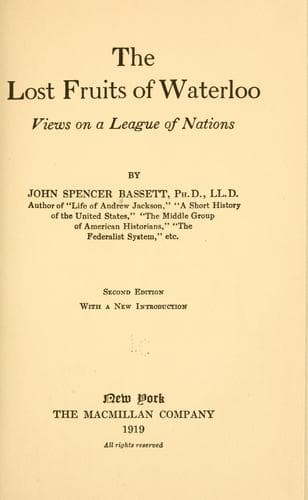
International cooperation; Peace; World War, 1914-1918
When Hegel preached the philosophy of war that underlies the German’s
devotion to war, he was largely right from the Prussian standpoint.
He held that the mind becomes sluggish through inactivity and that
war burns up its waste matter and leads to energy of character. This
doctrine would not be essentially true in any normally organized
society; for there are as many opportunities for self-expression in
commerce, finance, manufactures, art, and other peaceful occupations
as in war. But a century ago Prussia was filled, even more than today,
with a mass of small nobles, unaccustomed to any ordinary form of
labor, and with slender incomes. They were just the class that would
fall into the effete vices of an aristocracy. To them the military life
was an avenue of steady and moral employment. They took places in the
great machine, and by 1870 they had been bred into its very spirit. The
process saved the German nobles from vapidity. At the same time, as a
class, they preserved their political privileges, and it has happened
that they, with their official heads, the kaiser, kings, and princes,
have been able to unite political power and military purposes until
they have made of their country the most military state of modern
times. If Germany has fought the present war with great ability, it is
the organized autocracy that deserves the credit.
It is, therefore, the union of the political and military power in
the hands of a privileged class in Germany that now constitutes the
greatest obstacle to peace. It enables a small and efficient portion
of the German population to wield the rest of the people for the ends
they have decided are best. If this union of functions could be broken
up, and if political power could be distributed as in the countries
governed by the people, the obstacle would be reduced in size. It is
not necessary to suppose that it would be removed altogether; for even
if equal suffrage were established in Germany, and if autocracy were
shorn of its preponderating electoral power, the nobles would still be
the most capable class in the empire. Their personality would go a long
way in perpetuating their influence. If they played the game of trying
to lead the people they might remain rulers of Germany for a long time
after losing their present electoral advantages.
Public-domain text, read in full here on John Shaqi.
Reviews
Reviews
No reviews yet
Be the first to share your thoughts on this work.
Elsewhere in the archive
Join the Discussion
Join the discussion
Sign in to leave a comment or review.
Sign InorCreate an account