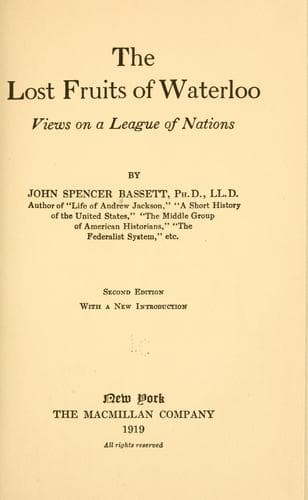
International cooperation; Peace; World War, 1914-1918
The advocate of peace points to the duel. There was a time when every
man felt it his right and duty to settle his own quarrels. He was
his own judge and his own sheriff. The result was so bad that law
was created to enforce peace between individuals. The old condition
survived in the duel, but in most countries this at last was brought
under the authority of law. Private combat in its nature does not
differ from public combat, and if one was eliminated by the creation of
a law that was strong enough to forbid it, the other can be abolished
by creating a still stronger law, powerful enough to restrain states as
criminal law restrains individuals.
Kant’s argument for perpetual peace ran like this, but he, in sympathy
with Rousseau’s social contract theory, argued that the law that
restrained individuals was the result of agreement between individuals;
and he went further and argued that all that was necessary to secure
perpetual peace would be for the states to agree to establish a league,
or a federation, to enforce it.
Now there was a fallacy in Kant’s argument that has a bearing on the
subject immediately before us today. There is no reason to suppose that
any state ever arose from an agreement of individuals. The ordinary
process was growth out of several conditions. An enlarged family might
become a state, or one tribe might conquer another and enlarge itself
into a state. Kinship and force were probably the chief causes in
producing the state; and reason seems to have played a small part.
Similarly, law grew up, not as the result of reason, but as a body of
tribal customs, reasonably interpreted by the wise men of the early
state.
There is, therefore, no analogy between the proposed method of forming
a great super-state with its own body of law, the object of which is
to restrain the states from going to war, and the method by which the
early state was created. In fact, if one great nation were to conquer
the rest of the world and impose its peace on all the world, as it
would do, we should have a process more analogous to the origin of the
early state. And that is one way of having peace. Within the last years
it has seemed a horribly possible method; for if Mittel-Europa becomes
a fact, it will have such predominating power that it is difficult to
see what will stop its march to general authority.
Pointing out Kant’s fallacy weakens his argument as such, but it leaves
us in such a dilemma that we are prone to pronounce his suggestion
worth trying as an escape from conquest by one great power. For if the
world is tending toward unity through conquest, who can doubt that it
would be better to anticipate the process, save a great sum of human
suffering, and by agreement found the world federation which is the
same result to which ages of war will lead us. That we could have such
a super-state by contract is not to be doubted. It would be as possible
as the creation of the United States of America by agreement.
Public-domain text, read in full here on John Shaqi.
Reviews
Reviews
No reviews yet
Be the first to share your thoughts on this work.
Elsewhere in the archive
Join the Discussion
Join the discussion
Sign in to leave a comment or review.
Sign InorCreate an account