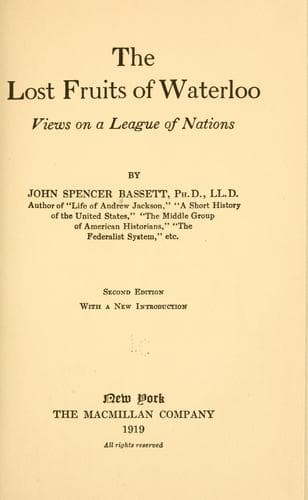
International cooperation; Peace; World War, 1914-1918
Then began a rebuilding process. Feudal states evolved out of clashing
duchies, counties, and bishoprics. Immediately feudal states began to
devour one another. With each century the unit of government became
larger. At last rose the great power of Spain, so great that it became
a threat to other powers, and then followed a series of wars to decide
whether or not Spain should be the supreme state in Europe, and Spain
lost. A century later France seemed to be seeking to establish herself
in the same kind of supremacy, and again the combined force of Europe
was necessary to break her purposes. Still later came the Napoleonic
wars, in which Europe seemed for a moment to be subjected by one
central will, but again it was saved through great suffering. To some
people it seemed that the Napoleonic attempt would be the last.
Of these modern struggles in Europe it is seen that each has been
harder than the struggle that preceded it. That is because in each the
implements and organization of warfare were improved as compared with
the former struggle, and because states were stronger and more capable
of endurance. It is also evident that each of these great wars was the
result of the ambition of one sovereign, supported by a strong and well
united nobility, while in each case the most effective resistance was
offered by the states in which some degree of self-government had been
adopted.
The struggle that now exists is the highest manifestation of this
tendency to unification that the world has seen since the fall of Rome.
Although Napoleon seemed at certain moments in his career to stand
nearer absolute success than Germany now stands, he never really gained
as much as the kaiser now holds; for he won his successes against the
poorly trained and dispirited troops of Prussia, Austria, and Spain,
while the Germans have won what they have won against some of the
best troops of history. Moreover, Napoleon’s power was founded on his
success solely, while the German victories rest on the long established
and certain foundation of the German empire. It seems reasonable to say
that Europe stands today nearer to unification than it has stood since
the fall of Charlemagne’s power.
Two great combinations are fighting for mastery. One has the avowed
purpose of extending its power until it is in a fair way to absorb the
rest of the states one after the other. The other group fights to beat
off the fate that threatens, and it acknowledges that it cannot succeed
unless it crushes its opponents into such a state as will take from
them the desire and the power to attempt another war for supremacy.
Whichever side wins, the other will feel an impulse to continue to act
in alliance. And we may have a Europe of two great federal states, with
the little states at their mercy.
Public-domain text, read in full here on John Shaqi.
Reviews
Reviews
No reviews yet
Be the first to share your thoughts on this work.
Elsewhere in the archive
Join the Discussion
Join the discussion
Sign in to leave a comment or review.
Sign InorCreate an account