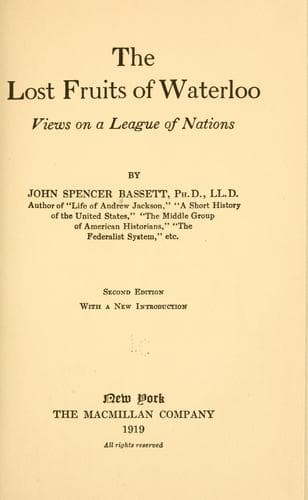
International cooperation; Peace; World War, 1914-1918
One result of the present war is to relegate these ideals into the
junk-heap of institutions, unless we can be assured that peace is a
certainty. Under a system of competition between states we cannot
afford to be less ready for war than any other great nation. We must
have a large navy and a great army ready to meet the blows of any
power that feels that it has reason to interfere with our peaceful
development. We must become a militaristic republic, a thing which
seems against nature. When such an attempt has been made in the past,
the result has been an oligarchy. In the United States it would
probably lead to a sad clash of social classes mingled with vicious
party politics and timidity in the national legislature. And yet, under
a continuation of the old system it would be folly to endeavor to get
along without an army and navy large enough to protect us from the
initial swoop of some powerful adversary.
If from this fate the advocate of coöperation can offer an escape, it
behooves us to listen to his scheme. We should weigh it carefully and
be willing to take some kind of a chance to secure its adoption, if in
it there is the possibility of successful operation.
To be perfectly fair to those who suggest leagues or federations we
should remember that we are not dealing with the ideas of pacifists, as
such. The schemes that are set forth by the friends of lasting peace
come from men who are giving all their energies to the prosecution of
the war. They believe, as much as any of us, that the war should be
pressed with every ounce of the nation’s strength. They are fighting as
hard as any one in the country, and they desire the defeat of Germany
as much as any soldier or statesman in the world. They are fighting to
establish a basis on which the peace of the world can be built. They
are not cranks, and even if they are mistaken, they are honestly trying
to call mankind to the better way.
One of their suggestions is a league of peace, to be composed of the
civilized nations. As we have seen, it is loosely organized and does
not allow the central authority of the league enough power to punish
a state that tries to withdraw from the league. Nor does it grant the
central authority the right to punish a state which, after submitting
its case to the proposed tribunal of arbitration and losing the
decision, decides to go to war in defiance of the tribunal’s judgment.
What would Germany do, for example, if she had lost such a judgment and
did not wish to accept her defeat? Strong and well prepared for war,
she might disregard all respect for the opinion of the world, if she
felt that her future was at stake, and we can hardly doubt that her own
people would support her.
Public-domain text, read in full here on John Shaqi.
Reviews
Reviews
No reviews yet
Be the first to share your thoughts on this work.
Elsewhere in the archive
Join the Discussion
Join the discussion
Sign in to leave a comment or review.
Sign InorCreate an account