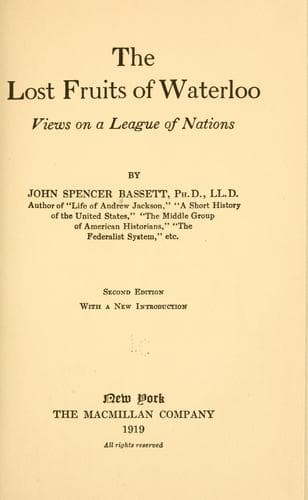
International cooperation; Peace; World War, 1914-1918
Great Britain had her advantage out of the bargain also. She retained
her position of paramount friend at Constantinople, justifying herself
with the assurance that the sultan would carry out reforms in his
empire. She seemed to think that the “Sick Man of Europe” would cure
himself under her guidance and then defend himself against states
that tried to oust him from his seat of power. To enable her to watch
the bedside of her patient from a convenient position, as well as
to safeguard the Suez Canal, Great Britain was given the right to
occupy and administer the island of Cyprus under nominal authority of
Turkey. To be perfectly fair we must admit that there is little moral
difference between her acquisition of Cyprus and Austria’s gain in
Bosnia and Herzegovina; and it is clear that in this case the Concert
of Europe was a concert for the gain of selfish ends. It is also worth
while to note that two of the Great Powers took no benefit from the
agreement. France was slowly recovering from the war of 1870-1871
and was in no condition to fight, although in 1881 she established
a protectorate over Tunis. The German Empire, newly founded and not
yet fully adapted to the imperial system, was also in no condition to
undertake a stiff encounter. There were many Germans who wished that
their government should not allow the other states to get large gains
of territory while Germany got nothing; but they yielded to Bismarck’s
wise policy which held that it was not yet time for Germany to assume
an aggressive position in the world. The impatience of the German
patriots lost nothing through having to wait.
No treaty ends the march of time, and the Balkan situation continued
to develop along the old lines. In 1881 Greece acquired Thessaly in
accordance with a promise made to her at the Congress of Berlin. In
1885 East Rumelia declared herself united to Bulgaria, acting in
defiance of the will of the Congress of Berlin. The Powers did not
interfere for the same reason that they did not act when Wallachia
and Moldavia united in 1862. To attempt to undo the union would have
precipitated a general war. The Concert was stronger to prevent a given
action than to correct it after it was done. Serbia, however, took
the action of the two provinces as a menace and declared war against
the new state of Bulgaria. She seemed about to throw herself on her
adversary when she suddenly made peace, evidently feeling she was not
strong enough to carry on the war alone.
Thenceforth the Powers showed that they did not mean to allow the
Balkan states to profit by seizing parts of the decaying Turkish
Empire. But for their restraint it seems that the Turk would have been
expelled from Europe before the end of the nineteenth century.
Public-domain text, read in full here on John Shaqi.
Reviews
Reviews
No reviews yet
Be the first to share your thoughts on this work.
Elsewhere in the archive
Join the Discussion
Join the discussion
Sign in to leave a comment or review.
Sign InorCreate an account