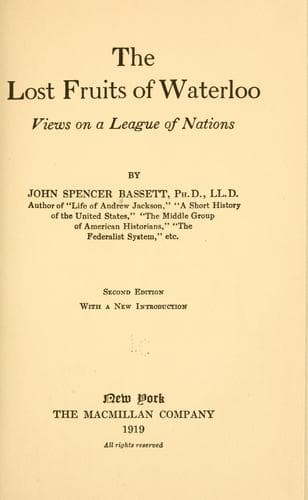
International cooperation; Peace; World War, 1914-1918
This chapter is not written to show that Germany was, or was not,
responsible for the war. If it explains how it was that the German
people believed that the war was forced on them, it will accomplish
more than it was designed to accomplish. But it is intended to enable
persons to keep calm heads in these times of perplexity in order to
understand how each side approached the great conflict. It is evident
that the _Entente_ powers thought that Germany wished to change Europe
into a great empire with herself at the head, while the central powers
felt that the chains were being riveted around about them.
In view of this long train of events the last week in that fateful July
assumes small proportions. If Ferdinand had not been killed war would
still have hung over the horizon. If Serbia had accepted the Austrian
ultimatum war would still have threatened; for though it may have been
averted for the moment, the Triple _Entente_ would still have existed,
nor would it have brooked the increase of German prestige that the
backdown of Serbia would have implied. If Russia had not mobilized her
army, Germany may not have mobilized, but the ancient fear of Russia as
an overwhelming opponent when she was once organized in the modern way
would have remained as a threat of dire consequences.
The theory of the Balance of Power is built upon the idea that states
act for their own interests in the restraint of one another from
overweening ambition. At bottom it is selfish. It assumes a state
of rivalry; and it is necessary to the theory that as fast as one
side gains in strength the other shall gain also. If the _Entente_
nations acquire Morocco, Tripoli, Cyrenaica, and parts of Persia, the
central powers must gain also or they are over-balanced. And who is to
determine how much they shall gain? Manifestly each will strive to get
all it can. The very process of gaining stimulates antipathy and makes
war a probability.
Another observation that is worthy of consideration is that balance is
logically possible only when more than two sides are opposed to one
another. When Great Britain, France and Russia had varying purposes
it was not difficult for Bismarck to play one against the other and
so keep the equilibrium. But when it happened that the central powers
became so strong that they constituted a threat against every other
nation in the world, it was natural for the other nations to unite to
check them. In such a condition no true balance of power could exist,
and it was folly to expect that theory to serve as it served in former
days.
Public-domain text, read in full here on John Shaqi.
Reviews
Reviews
No reviews yet
Be the first to share your thoughts on this work.
Elsewhere in the archive
Join the Discussion
Join the discussion
Sign in to leave a comment or review.
Sign InorCreate an account