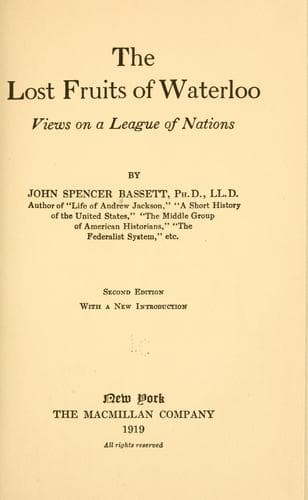
International cooperation; Peace; World War, 1914-1918
Of course, there is the difficulty that the United States may not
be guided by statesmen who realize the importance of following a
thoroughly American policy. It has long been a practice with a great
many Americans to follow the lead of Great Britain. Unaccustomed to
take a normal share of responsibility in world problems, we may now be
inclined to hold back, leaving the game to hands that have acquired
greater skill in playing it. Such a course would be a misfortune. It
would mean that statesmen would be given charge of the situation who
derived all their ideas under the old system of Balance of Power, and
it would be strange if they did not try to carry on the world in the
future with a strong squint at the only principles of international
policy they know anything about. To break into this well crystallized
realm of so-called practical ideas, demands an unusually strong man,
a man well founded in principles and able to convince others of the
wisdom of his views.
It is true that the President of the United States now in office has
many of the traits that seem necessary to a correct conduct of the
situation. A man who had the training of a mere politician might well
be less than able to deal with the situation that faces us. President
Wilson’s knowledge of history enables him to think in terms of large
national movements. That is the chief value of historical training to
a statesman. If he knows the history of the attempts to settle the
affairs of the nations after the great world struggles of the past, he
is better able to understand how the various suggested plans will work
in the crisis that is to be passed through.
President Wilson has, also, the unusual faculty of doing what he wishes
to do. When he has formed a purpose it is not generally a compromise
with a number of men whose chief concern is how the result of action
will affect their party support. At least this is true in matters not
clearly within the bounds of party activity. Moreover, he has spoken
and written words which seem to show that he understands the need of
providing for such a course of conduct between the nations as will
assure us of coöperation for the elimination of future wars. In his
long delay in urging war and in his early pronouncement for a league of
peace, he gave us the assurance, if nothing else, that he understands
the situation and is capable of holding a firm course in accordance
with his principles.
Public-domain text, read in full here on John Shaqi.
Reviews
Reviews
No reviews yet
Be the first to share your thoughts on this work.
Elsewhere in the archive
Join the Discussion
Join the discussion
Sign in to leave a comment or review.
Sign InorCreate an account