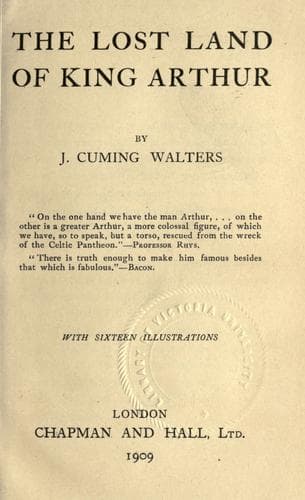
Arthur, King -- Homes and haunts -- England -- Cornwall (County); Cornwall (England : County) -- Antiquities, Celtic
“The grave of March is this, and this is the grave of Gwyther,
Here is the grave of Gwgawn Gleddyfrudd,
But unknown is the grave of Arthur.”
The more popular and more befitting tradition deviates entirely from
any commonplace termination of King Arthur’s career, and gives a
magical end to his miraculous history. The king’s brand, Excalibur or
Calibur, the emblem of his kingship and the symbol of his power, the
sword which he alone could wield, and by winning which he had gained
his crown, was given to Sir Bedivere by the dying chief to return unto
the Lady of the Lake. “My time hieth fast,” said the king; “therefore
take thou Excalibur, my good sword, and go with it unto yonder
waterside, and when thou comest there I charge thee, throw my sword
into that water, and come again and tell me what thou shalt see.” Twice
did Sir Bedivere falteringly go to dark Dozmare Pool, a melancholy
sheet of water overshadowed by high and dreary hills which seem to keep
gloomy watch over Camelford. Twice did Sir Bedivere’s heart fail him,
and instead of flinging the wondrous sword into the depths, supposed to
be unfathomable, of the black lake, he hid it among the many-knotted
waterflags that whistled stiff and dry about the marge. “Authority
forgets a dying King,” said Arthur to the faithless knight; but for the
last time asserting his power, he threateningly bade him to fulfil his
task; and the knight ran, leapt down the ridges, and threw the splendid
brand into mid-water.
“But ere he dipt the surface, rose an arm
Clothed in white samite, mystic, wonderful,
And caught him by the hilt, and brandish’d him
Three times, and drew him under in the mere.”[29]
Poets, in describing this scene, have found it scarcely possible to
do other than follow closely the words of Malory, which relate the
incident with directness and yet with a charm of picturesqueness
scarcely to be surpassed except by much elaboration--and elaboration
would be out of place in such a case, and would destroy the subtle
effect of the narrative. After telling of the hiding of the sword by
the reluctant knight, and of Arthur’s indignation at his evasive words
and long tarrying, the chronicler says:--“Then Sir Bedivere departed,
and went to the sword, and lightly took it up, and went to the water
side, and there he bound the girdle about the hilts, and then he threw
the sword as far into the water as he might, and there came an arm
and a hand above the water, and met it, and caught it, and so shook
it thrice and brandished it, and then vanished away the hand with the
sword in the water.” “The hand that arose from the mere,” says Renan,
“is the hope of the Celtic heroes. It is thus that weak people, dowered
with imagination, revenge themselves on their conquerors. Feeling
themselves to be strong inwardly and weak outwardly, they protest, they
exult, and such a strife unloosing their might renders them capable of
miracles.”
Public-domain text, read in full here on John Shaqi.
Reviews
Reviews
No reviews yet
Be the first to share your thoughts on this work.
Elsewhere in the archive
Join the Discussion
Join the discussion
Sign in to leave a comment or review.
Sign InorCreate an account