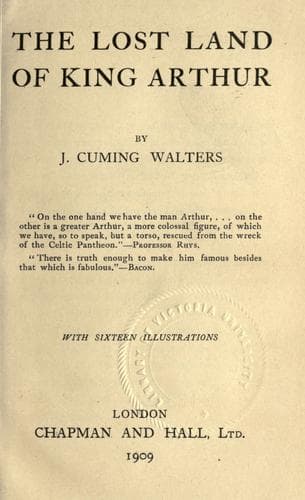
Arthur, King -- Homes and haunts -- England -- Cornwall (County); Cornwall (England : County) -- Antiquities, Celtic
almost as they were first designed and made. Side by side stand “Ye
Olde Pilgrim’s Inne” and the Tribunal, or Court House, built by Abbot
Beere, for the trial of petty offenders against the law. Unexplored
dungeons are reported to exist underground, together with subterranean
passages communicating with the Abbey from the “Inne” and the Tribunal.
In the neighbourhood is a conspicuous building once used for collecting
the tithes, called the Abbey Barn, dating from 1420, in some respects
the best preserved of all the ancient memorials. But the pride and
glory of Glastonbury centre in the wondrously beautiful remains of
the oldest, richest, and stateliest of English Abbeys--an Abbey whose
reputed founder was Joseph of Arimathæa, that Joseph who had seen the
face and heard the voice of the Saviour of mankind. It was the only
church of first rank in England standing as a monument of British days
which escaped the scath and wreck which followed the storm of Norman
conquest.
[Illustration: THE OLDE PILGRIM’S INN, GLASTONBURY
[_To face p. 222_]
To what dim epoch the earliest history of Glastonbury belongs is more
or less conjectural, though the discovery of some sixty low mounds
by archæologists led to the discovery that a prehistoric lake-village
in remote times occupied the site. Excavations revealed the remains
of human habitations and of successive occupation by the same race--a
race which hunted the boar, the roebuck, and the deer, and whose sole
accomplishment was the making of coarse, rude pottery. But this people
has passed away and not even a tradition of its existence is extant.
It was at a much later period, though, looking backward, the time
seems far distant, that the first legend of Glastonbury took root and
flowered. So pure, fragrant, and beautiful is that treasured blossom
that it would seem ruthless to attempt to pluck it by the roots from
the ground, and to cast it aside as a worthless weed of ignorance and
superstition. It brings to us the memory of that time when the Son of
Man was on earth; it is a seed blown from that land which His presence
sanctified. Nearly two thousand years ago the crucified Nazarene was
watched by agonised crowds upon Calvary. Joseph of Arimathæa, “a
good man and a just,” begged the dead body from Pilate and buried it
in his own garden, thereby incurring the fierce resentment of the
Jews. He fled from Palestine, fearing for his life, and so enraged
were his enemies at his escape that they expelled his friends
also--Lazarus, Mary Magdalene, and Philip among others--putting them
out to sea without oars or sail. “After tossing about many days,” says
one writer, “they were driven in God’s providence to Marseilles, and
from Marseilles St. Joseph came to Britain, where he died at a good
old age, after having preached the Gospel of Christ with power and
earnestness for many years.” This was about A.D. 63. “The happy news of
the Saviour’s resurrection, and the offer of the only assured means of
Public-domain text, read in full here on John Shaqi.
Reviews
Reviews
No reviews yet
Be the first to share your thoughts on this work.
Elsewhere in the archive
Join the Discussion
Join the discussion
Sign in to leave a comment or review.
Sign InorCreate an account