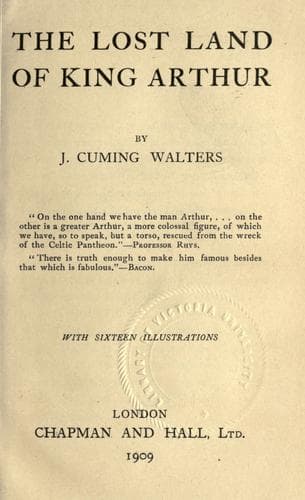
Arthur, King -- Homes and haunts -- England -- Cornwall (County); Cornwall (England : County) -- Antiquities, Celtic
This is one of the insoluble mysteries. The remains of Arthur and
Guinevere are stated to have had noble burial by King Henry’s command
in “a fair tomb of marble,” and the cross of lead bearing the
original inscription was placed in the church treasury. At the
suppression of the monasteries it is assumed that all the tombs and
monuments shared one fate. Edward I and his queen visited Glastonbury
in 1278, and after seeing the shrine, fixed their signets upon the
separate “chests” in which the dust was deposited. Within the sepulchre
they placed a solemn written record of what they had seen, together
with the names of the principal witnesses. King Edward is also said to
have had Arthur’s crowns and jewels rendered to him. He and his queen
were satisfied that they had gazed upon “the bones of the most noble
Arthur”; and theirs were the last eyes to see the remains, false or
true. The historian Speed, in indignant strain, tells of the doom that
befell the Abbey in Henry VIII.’s days, when “this noble monument,
among the fatal overthrows of infinite more, was altogether razed by
those whose over-hasty actions and too forward zeal in these behalfs
hath left us the want of many truths, and cause to wish that some
of their employments had been better spent.” Whatever sign of King
Arthur’s tomb, real or pretended, had existed, thus vanished for ever,
and the prophesied mystery of his grave became fulfilled.
All that now remains in association with his name, and his final acts,
and his uncomprehended fate, is the Abbey, surpassingly beautiful in
ruin, founded in times faded almost from the recollections of a race;
it is itself half mystery and half monument. The stateliest of its
chambers still bears the name of St. Joseph’s Chapel, and itself with
its delicate tracery, its exquisitely designed windows, its carved
pillars, is like a fairy tale in stone. The little church built with
wattles from the marsh became the church triumphant and the church
supremely beautiful in after-time. When the second Henry visited it
the already venerable Abbey was a pile of architectural wonders and
magnificence, thanks to the labours of Abbot Harlewinus. It was he who
designed and erected that veritable gem of architecture, gorgeously
ornamented and finished in classic grace, which serves as memorial to
the first Christian saint in England. “Imagination cannot realise,”
says one chronicler, “how grand and beautiful must have been the
view from St. Joseph’s Chapel through its long-drawn fretted aisles
up to the high altar with its four corners, symbolising the Gospel
to be spread through the four quarters of the world.” The matchless
temple was over a hundred feet longer than Westminster Abbey; and its
spaciousness was only equalled by its riches. Lofty mullioned windows
rose nearly to the vaulting, richly dight and casting a dim religious
light; and the profuse decorations of the walls took the form of
Public-domain text, read in full here on John Shaqi.
Reviews
Reviews
No reviews yet
Be the first to share your thoughts on this work.
Elsewhere in the archive
Join the Discussion
Join the discussion
Sign in to leave a comment or review.
Sign InorCreate an account