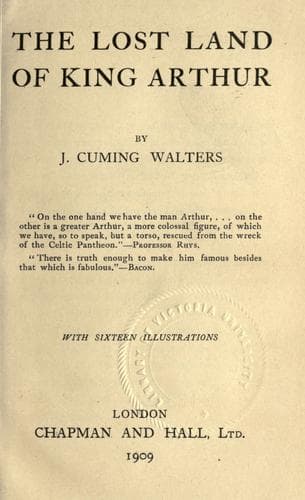
Arthur, King -- Homes and haunts -- England -- Cornwall (County); Cornwall (England : County) -- Antiquities, Celtic
[18] Silchester, originally a Celtic fortress, and a city of the
size of London, is also reported to have been the scene of Arthur’s
coronation at the age of fifteen by Dubritius. Modern excavations
have proved the importance of the city as a great centre of life and
industry, in Roman and British times, with its Forum, Basilica, and
rows of shops and houses; and if the _Calleva Attrebatum_ were really
Arthur’s crowning place, its fitness and worth for so imposing an event
cannot be disputed. Although Silchester is not directly referred to in
the Romances, Arthur’s Hampshire connections are numerous. They centre
in Winchester, where his predecessor and foster-father, Ambrosius
Aurelianus, died in the year 508. It was at Silchester also that the
chief men of the provinces met after Uther Pendragon’s death and
petitioned Dubritius, Archbishop of Caerleon, to consecrate Arthur the
successor to the dead king.
[19] Of this wooden bridge G. W. Manby in his _Guide_ (published 1802)
gives an illustration, and says: “As numerous coins have been found
where the piles of the bridge are now placed, there is no doubt of its
being the original pass. To a person unaccustomed to such a bridge, the
rattling noise whenever any weight is going over naturally occasions
some apprehensions.... The accounts of the tide rising so high as to
cover the bridge are erroneous; it never has been known yet; but that
assertion has given rise to the idea of the bridge being purposely
loose to prevent its being carried away in such cases. The amazing
floods to which the river is subject would render it not surprising if
accidents did happen.” Tennyson, who obtained from the _genius loci_
both inspiration and enlightment, refers in _Geraint and Enid_ to the
rapidity of the turn of the tidal waters of the Usk:--
“Scarce longer time
Than at Caerleon the full-tided Usk,
Before the time to fall seaward again,
Pauses.”
Modern Caerleon, however, with its commonplace railway station, its
porters shouting “Car--lion,” its new bridge, its spoilt Norman
church, and its street of small dwelling-houses, is likely at first to
disappoint the pilgrim, who only by searching and waiting can hope to
find the links with the city’s historic past.
[20] Frere’s poem was caustic, but it had a certain value in showing
the unromantic side of Arthurian times. The following verses, than
which far less delicate ones could be found in the poem, may be taken
as a specimen:--
“And certainly they say, for fine behaving
King Arthur’s Court has never had its match;
True point of honour, without pride or braving,
Strict etiquette for ever on the watch;
There manners were refined and perfect--saving
Some modern graces which they could not catch,
As spitting through the teeth, and driving stages,
Accomplishments reserved for distant ages.
Public-domain text, read in full here on John Shaqi.
Reviews
Reviews
No reviews yet
Be the first to share your thoughts on this work.
Elsewhere in the archive
Join the Discussion
Join the discussion
Sign in to leave a comment or review.
Sign InorCreate an account