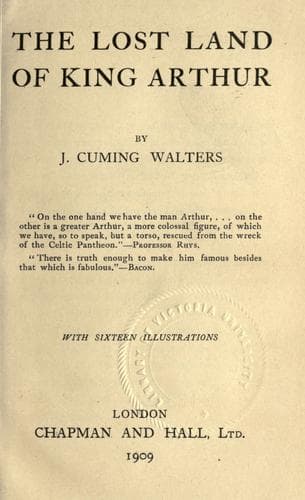
Arthur, King -- Homes and haunts -- England -- Cornwall (County); Cornwall (England : County) -- Antiquities, Celtic
[28] The ancient ballad, discovered, annotated, and to a slight extent
supplemented, by Dr. Percy, follows very exactly the story of Arthur’s
last days as given in the romances except that it ascribes to Sir Lucan
the acts usually credited to Sir Bedivere. Not a detail is omitted,
not a point is missed. On the morning of Trinity Monday the ghost of
Sir Gawaine is said to have appeared to the king and warned him not to
fight if he prized his life, but to wait until Sir Lancelot returned
from France. The parley which followed between Arthur and Mordred is
next described, but just as a month’s league had been decided upon
the adder’s sting brought about the “woeful chance As ever was in
Christentie.” When the wounded knight drew his sword the two hosts
immediately “joined battayle,” and fought until only three men were
left alive.
[29] It is interesting to compare Tennyson’s lines with Longfellow’s
in _The Spanish Student_, the similarity of phrasing being so marked.
Victorian, the student, observes that it is in vain he throws unto
oblivion’s sea the sword [of love] that pierces him--
“For like Excalibur,
With gemmed and flashing hilt it will not sink.
There rises from below a hand that grasps it,
And waves it in the air: and wailing voices
Are heard along the shore.”
[30] Glastonbury occupies a former site of Druidical worship, and
Professor Rhys believes the name to be a corruption of the British
word _glasten_, an oak, the Druids cultivating both the oak and the
apple as foster parents of their sacred mistletoe. Glestenaburh, says
Canon Taylor, was assimilated by the Saxons to their gentile form
Glestinga-burh or Glæsting-burh, which being supposed by a false
etymology to mean the “shining” or “glassy” town was mistranslated by
the Welsh as Ynys-Widrin, the Island of Glass.
[31] William Morris slightly varied the story in his _King Arthur’s
Tomb_, when he represents Lancelot journeying to “where the Glastonbury
glided towers shine” and relates that
“Presently
He rode on giddy still, until he reach’d
A place of apple-trees, by the Thorn-Tree
Wherefrom St. Joseph in the past days preach’d.”
[32] The Holy Grail is pointed out in particular at Genoa Cathedral.
“It was brought from Cæsarea in 1101, is a hexagonal dish of two palms’
width, and was long supposed to be of real emerald, which it resembles
in colour and brilliancy.”
[33] Some historians, perhaps with better reason, declare that he was
born in 405 at Kilpatrick, Dumbarton, a little town at the junction of
the Levin and Clyde. He is variously reported to have died in 493 and
507, some placing his age at 88, and others at 120.
* * * * *
Transcriber’s Notes:
Italic text is denoted by _underscores_ and bold text by =equal signs=.
Variations in spelling and hyphenation remain as in the original unless
noted below.
Public-domain text, read in full here on John Shaqi.
Reviews
Reviews
No reviews yet
Be the first to share your thoughts on this work.
Elsewhere in the archive
Join the Discussion
Join the discussion
Sign in to leave a comment or review.
Sign InorCreate an account