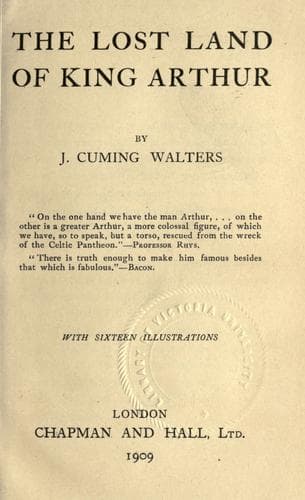
Arthur, King -- Homes and haunts -- England -- Cornwall (County); Cornwall (England : County) -- Antiquities, Celtic
Galahad’s story was a late addendum to the Arthurian legend, and it
is very difficult to suppose that he was an historic figure. Yet his
prototype is said to have existed in the person of Catwg the wise
(Cadog), the second principal of Llancarfan College, where he was the
successor of the renowned Bishop Dubois. In his youth Catwg had been
a soldier, later he joined the Christian Church, and the neophyte had
the advantage of receiving personal instruction from the aged master,
the foremost divine of Arthur’s time. But the suggestion that Cadog was
Galahad is scarcely open to serious consideration, and Walter Map, the
first to relate the history of the virgin knight, was not likely to
have had any such prototype in his mind. His conception seems to have
been mainly poetic. The story is crowded with mysteries, superstitions,
and idealisms. Galahad is scarcely human in any of his attributes, and
he is so invested with marvels that we may safely set him down as an
imaginary type or the most shadowy of traditional figures.
In discussing the real Arthur, as distinct from the Arthur of romance,
we have to bear in mind that he was primarily the warrior, the
representative of a cause which necessitated the constant display of
his power in battle. As such he was first celebrated by the bards, and
it was around the warrior and chief that the romance grew. From being
simply a military leader, he became a type of hero about whom gathered
many legends, and in course of time he was made the central figure in
all the stories of marvellous adventure current in the early days. That
there was an Arthur leading a forlorn hope, chief of a people slow
to yield and hard to subdue, need scarcely be questioned. He is the
original hero, the last and greatest of a conquered race; he is the
giant-figure standing behind the mythical Arthur of fable and romance.
Born when his land was attacked by the invader and his people were
fearing extinction, he valorously met the foe, and for a while stemmed
the victorious current of the Saxon and the Roman arms. Defeated at
last, he became, as was inevitable, a type of hero--a later Odin, a
demi-god--and in the romances and songs we read rather of aims than
accomplishments, of desires than of deeds. More and more as time cast
its glamour about him, King Arthur became the embodiment of a national
aspiration, and the vanquished race revenged its defeat in songs of
defiance, songs which vaunted of victory and were matched to triumphant
strains, songs which relieved the thought of present disaster and
recalled only the olden triumphs or prompted dreams of future glory.
These songs took their rise in prophecies and sprang forth into golden
promise of power and success. Speedily the ideal replaced the real.
Poet after poet, chronicler after chronicler, added attributes to the
hero; and ultimately from one strong man waging desperate war against
outnumbering foes, the Arthur of romance was evolved, the Arthur whose
Public-domain text, read in full here on John Shaqi.
Reviews
Reviews
No reviews yet
Be the first to share your thoughts on this work.
Elsewhere in the archive
Join the Discussion
Join the discussion
Sign in to leave a comment or review.
Sign InorCreate an account