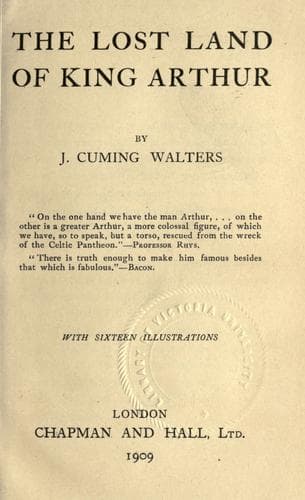
Arthur, King -- Homes and haunts -- England -- Cornwall (County); Cornwall (England : County) -- Antiquities, Celtic
It is surprising that Badon[23] should remain vague and undefined,
when the sites of some of the other and less important battles are
in most cases not dubious and are easily ascertained. We know, for
example, that Barham Down, or Barendowne, the scene of one of the
last encounters with Mordred, was near Canterbury; and the fact that
thereabouts was an Anglo-Saxon cemetery may either be testimony to the
fact, or may have suggested to the chroniclers the likelihood of its
being an ancient battlefield. Mr. Ritson traced the localities of the
other Arthurian struggles to the banks of the Glen in Lincolnshire
and of the Duglas in Lancashire; he thought Bassas might be Bashford
in Staffordshire, though others favour Boston in Lincolnshire;
Cathbregion was in Somersetshire, and so forth. Of these battles we
have no details in Malory. On the other hand, we have a long account
of the expedition to Italy undertaken by Arthur against the Emperor
of Rome after the latter had presumed to demand tribute from him. His
complete humiliation of the Emperor’s subjects is, of course, insisted
upon. Prisoners were taken in large numbers and compelled to become
Christians; a duchess besought him to spare the women and children, and
Arthur thereupon issued magnanimous orders; the keys of cities were
brought to him by young men, and his march through northern Italy was
one continuous triumph. “Then he rideth into Tuscany,” says Malory in
his most laconic style, “and winneth towns and castles, and wasted all
in his way that to him will not obey.” Finally the senators offered
him allegiance, and the noblest cardinals in Rome came voluntarily to
him and “prayed him peace.” Arthur accepted their gifts, and decided
to hold his Table Round, “with my knights as we liketh,” in Rome at
Christmas. Then, having been crowned by the Pope “with all the royalty
that could be made,” he apportioned the realms among his knights and
servants, and returned to England, landing at Sandwich,[24] where the
queen and a large company were waiting to receive him. King Arthur, his
knighthood, his undefeated warriors, and his almost miraculous battles,
are perhaps more a theme for the poet than for the historian. Such
lines as Lytton’s accord with the romance, and realise the aspirations
of the unsubjugated tribe and of those who sang its fame and prophesied
its future triumph.
“Rings Owaine’s shout,--rings Geraint’s thunder-cry,
The Saxon’s death knell in a hundred wars;
And Cador’s laugh of triumph:--through the sky
Rush tossing banderolls swift as shooting stars,
Trystan’s white lion--Lancelot’s cross of red,
And Tudor’s standard with the Saxon’s head.
And high o’er all, its sealèd splendour rears
The vengeful emblem of the Dragon Kings.
Full on the Saxon bursts the storm of spears;
Far down the vale the charging whirlwind rings,
While through the ranks its barbèd knighthood clave,
All Carduel follows with its roaring wave.”
CHAPTER VII
Public-domain text, read in full here on John Shaqi.
Reviews
Reviews
No reviews yet
Be the first to share your thoughts on this work.
Elsewhere in the archive
Join the Discussion
Join the discussion
Sign in to leave a comment or review.
Sign InorCreate an account