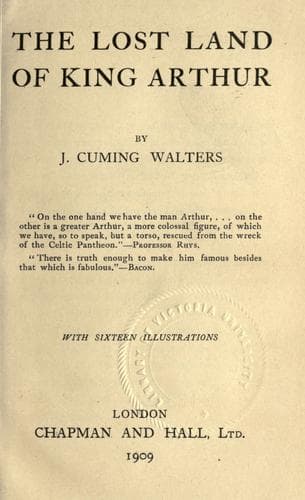
Arthur, King -- Homes and haunts -- England -- Cornwall (County); Cornwall (England : County) -- Antiquities, Celtic
To Camelot the knights sent their prisoners to do homage to King Arthur
and confess his greatness. The church of St. Stephen’s, often called
the Minster, was the place where the king and his followers assembled
to hear the Archbishop’s blessing upon their enterprises, and in the
adjoining grounds the principal men slain in battle were buried with
all honour. The twelve kings who fell in war with King Lot “were
buried in the church of Saint Stephen’s, in Camelot, and the remnant
of knights and of other were buried in a great rock,” so one of the
records runs. By the side of Lanceor’s tomb, made by Merlin, Tristram
and Lancelot encountered each other and “fought together unknown,”
and “either wounded other wonderly sore, that the blood ran out upon
the grass”; then, discovering that they were friends, they yielded up
their swords, “either kissed other an hundred times,” and rode back to
Camelot. Elaine, the mother of Galahad, came to Camelot richly attired,
and put Lancelot to shame, and it was at Camelot that the last sad
scenes in their tragic drama were enacted. The quest for the Sancgreal
began there, and King Arthur, full of forebodings, took a last review
of his knights and caused them to assemble for a last tournament in
Camelot’s meadows, “that after your death men may speak of it, that
such good knights were wholly together such a day.” The queen and
her ladies beheld the noble gathering from her tower, and saw Sir
Galahad, the perfect knight, break the spears of all who came against
him save that of his father, Sir Lancelot, and that of his compeer Sir
Percivale. When next we read of Camelot, Arthur is regretting the loss
of half his noble company; and when the worst had come to pass, and the
king discovered the wrong done to him by Lancelot and Guinevere, it
was of lonely Camelot he thought with tenderest regret. Tennyson has
seized upon this idea, and put into the mouth of the king the mournful
soliloquy as he muses on his faithless wife--
“How sad it were to live
And sit once more within the lonely hall,
And miss the wonted number of my knights,
* * * * *
And in thy bowers of Camelot or of Usk
Thy shadow still would glide from room to room,
And I should evermore be vexed with thee
In hanging robe or vacant ornament
Or ghostly footfall echoing on the stair.”
This was when the time was come that Arthur should see Camelot no
more--when he had gone forth to his last fight, and Guinevere had taken
the nun’s habit and immured herself in Almesbury.
Public-domain text, read in full here on John Shaqi.
Reviews
Reviews
No reviews yet
Be the first to share your thoughts on this work.
Elsewhere in the archive
Join the Discussion
Join the discussion
Sign in to leave a comment or review.
Sign InorCreate an account