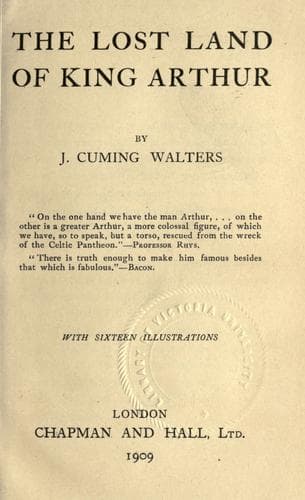
Arthur, King -- Homes and haunts -- England -- Cornwall (County); Cornwall (England : County) -- Antiquities, Celtic
From Camelot to Almesbury is a far journey, and that journey marks the
two extremes of Arthurian history from the happiest to the saddest,
from the height of power and the plenitude of peace to the final
desolation and unavailing regret. The bridge which connects Camelot
with Almesbury is made up of the greatest achievements and the deepest
tragedies of Arthur’s reign. It is a bridge of ascent and descent, its
highest point marked by the puissance of the Table Round and Galahad’s
achievement of the quest of the Grail, its lowest part dipping into the
eternal gloom which followed the last battle in the west--a gloom from
which the Britons were destined never to emerge. That gloom falls over
Almesbury, but Camelot is still left in the light.
Never was, and never can be, such a fairyland as “many-tower’d
Camelot.” Its crystal dykes, its slope street, its weird white gate,
and its spires and turrets without number, are a poet’s dream. It
was the city of enchanters, built by fairy kings, a city which had no
beginning, was raised by no human hands, and can have no end--
“A city of shadowy palaces,
And stately, rich in emblem and the work
Of ancient Kings who did their days in stone,”
a city of pure delights, of calm and innocence, of splendour and
contentment.
“Out of bower and casement shyly glanced
Eyes of pure women, wholesome stars of love;
And all about a healthful people stept
As in the presence of a gracious king.”
Where, indeed, could be this new Eden save in the imagination of the
romancer who conceived a fitting scene for King Arthur’s Court? It
is like the fairy gold which vanishes whenever a hand reaches out to
touch it. The “Camaletic Mount” is one of Nature’s hallowed places, a
place of wondrous stillness and magic charm, a place to regard as the
stronghold of romance, and yet not the place that poets have sung. One
can easily imagine the Lady of Shalott prisoned here in her bower, and
seeing all the moving world as shadows in a mirror; and one can deem
the scene appropriate for the meeting of Lancelot and the Lily-maid who
lifted up her eyes and lov’d him with that love which was her doom. It
is not well to inquire more deeply and more closely into the past of
Camelot, but to heed the poet’s warning--
“Never seek to behold
Where the crystal streams ran in the City of Gold.”
Better to people it with the phantoms of Arthur’s Court than to
discover that the cavemen of the Mendips made it an abode. “The people
can telle nothing ther, but that they have hard say that Arture much
resorted to Camalot,” wrote Leland, and that suffices. Camelot is
purely ideal, and it is enough to find a real Camelot which faintly
recalls the place which Arthur’s eulogists deemed fitting for his
Court. Such cities, which had no beginning, have no end, and Camelot
will last as long, and prove as indestructible, as Fairyland itself.
Public-domain text, read in full here on John Shaqi.
Reviews
Reviews
No reviews yet
Be the first to share your thoughts on this work.
Elsewhere in the archive
Join the Discussion
Join the discussion
Sign in to leave a comment or review.
Sign InorCreate an account