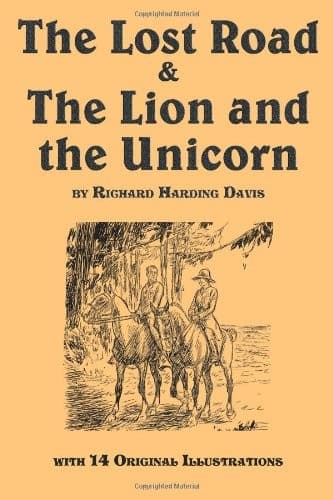
Young Everett at last was a minister plenipotentiary. In London as
third secretary he had splashed around in the rain to find the
ambassador's carriage. In Rome as a second secretary he had served as
a clearing-house for the Embassy's visiting-cards; and in Madrid as
first secretary he had acted as interpreter for a minister who, though
valuable as a national chairman, had much to learn of even his own
language. But although surrounded by all the wonders and delights of
Europe, although he walked, talked, wined, and dined with statesmen and
court beauties, Everett was not happy. He was never his own master.
Always he answered the button pressed by the man higher up. Always
over him loomed his chief; always, for his diligence and zeal, his
chief received credit.
As His Majesty's naval attache put it sympathetically, "Better be a
top-side man on a sampan than First Luff on the Dreadnought. Don't be
another man's right hand. Be your own right hand." Accordingly when
the State Department offered to make him minister to the Republic of
Amapala, Everett gladly deserted the flesh-pots of Europe, and, on
mule-back over trails in the living rock, through mountain torrents
that had never known the shadow of a bridge, through swamp and jungle,
rode sunburnt and saddle-sore into his inheritance.
When giving him his farewell instructions, the Secretary of State had
not attempted to deceive him.
"Of all the smaller republics of Central America," he frankly told him,
"Amapala is the least desirable, least civilized, least acceptable. It
offers an ambitious young diplomat no chance. But once a minister,
always a minister. Having lifted you out of the secretary class we
can't demote you. Your days of deciphering cablegrams are over, and if
you don't die of fever, of boredom, or brandy, call us up in a year or
two and we will see what we can do."
Everett regarded the Secretary blankly.
"Has the department no interest in Amapala?" he begged. "Is there
nothing you want there?"
"There is one thing we very much want," returned the Secretary, "but we
can't get it. We want a treaty to extradite criminals."
The young minister laughed confidently.
"Why!" he exclaimed, "that should be easy."
The Secretary smiled.
Public-domain text, read in full here on John Shaqi.
Reviews
Reviews
No reviews yet
Be the first to share your thoughts on this work.
Elsewhere in the archive
Join the Discussion
Join the discussion
Sign in to leave a comment or review.
Sign InorCreate an account