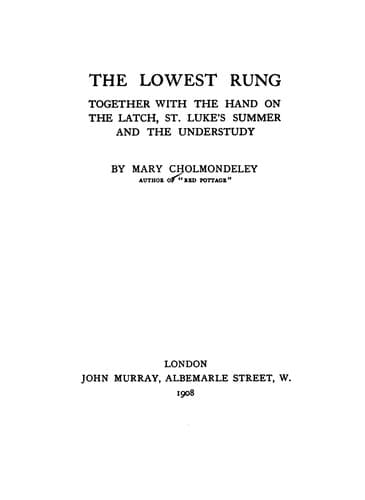
The Lowest Rung: Together with The Hand on the Latch, St. Luke's Summer and The UnderstudyCholmondeley, Mary
General
The Lowest Rung: Together with The Hand on the Latch, St. Luke's Summer and The Understudy
Cholmondeley, Mary
Short stories, English
_Was Delacour acting?_ Marion knew that he was not. And as the play
proceeded it changed in character. The words were the words she had
written. Many of them were the words he had used himself, but his
passion transformed them. They took on a new meaning. It was Maggie who
was becoming a mean figure in spite of her grandiloquence--perhaps
because of it. Her rigid principles, her petty, egotistic pride, her
faultless demeanour jarred on the audience. Lenore, like a true artist,
caught the novel side of the situation and emphasised it. Her Maggie
dwindled, dwindled, until the man held the stage alone, dominated it.
Marion had never before seen his side of the miserable drama in which
her happiness had made shipwreck, had never before seen her own
character in this light. It was as if he were saying the truth at last,
defending himself at last--which he had never done in real life.
Finally repulsed, silent under her scornful invective, Delacour gathered
himself together and went off magnificent in defeat.
The curtain fell for the last time.
The tiny audience, strengthened by the rest of the cast who were not
needed in the final scene, broke into rapturous applause. The manager,
excited and radiant, clapped with the rest.
"He's immense. He's immense!" he kept on saying. "Delacour's the making
of it. He's immense! Hang Montgomery! He may have bronchitis till he's
blue. Delacour makes the play. I will fetch him!"
He disappeared behind the curtain, and in a few minutes reappeared,
dragging Delacour with him to introduce him to Marion.
"We have met before," she said faintly, putting out her hand.
"Did we ever really meet?" he said gently, taking it for a second in
his.
He seemed quite exhausted. Now that she saw him close at hand, he looked
much older. And his face was grievously lined, deteriorated.
She tried to thank him, to express her gratitude for the way he had
extricated them from a great difficulty; but her words were so
hesitating and frigid that the manager broke in, shaking him warmly by
the hand.
Delacour bowed his thanks, murmured something conventional, and was
gone.
Every one was in a hurry to go, too. Marion remained a moment longer
talking to the manager, and then they went together through the royal
box to the private entrance, where her brougham was waiting. Just as
they reached it, he was called away, and an attendant let her out.
Waiting beside her brougham, in the rain, holding the door for her, was
Delacour, in a shabby overcoat, his hat in his hand.
Again their eyes met in a long look. His, sombre, melancholy, humble,
had a great appeal in them.
She seemed encased in some steel armour, which made movement and speech
wellnigh impossible. She thanked him inaudibly.
He shut the door, said "Home" to the coachman, and turned away.
The carriage drove off.
Public-domain text, read in full here on John Shaqi.
Reviews
Reviews
No reviews yet
Be the first to share your thoughts on this work.
Elsewhere in the archive
Join the Discussion
Join the discussion
Sign in to leave a comment or review.
Sign InorCreate an account