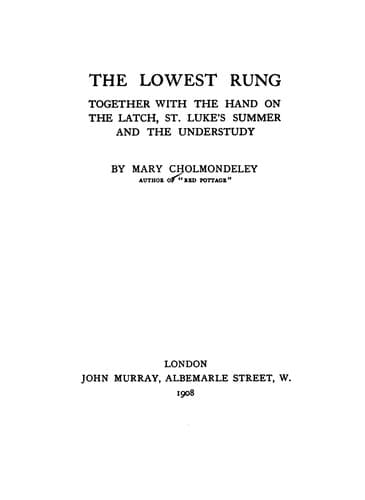
The Lowest Rung: Together with The Hand on the Latch, St. Luke's Summer and The UnderstudyCholmondeley, Mary
General
The Lowest Rung: Together with The Hand on the Latch, St. Luke's Summer and The Understudy
Cholmondeley, Mary
Short stories, English
After all, it did not matter. She would get his address from the manager
first thing to-morrow, and go straight on and see him, and sacrifice her
pride, and beseech him to take her back. She had been too proud. She
saw that at last. She would say so. She saw at last that resentment is
disloyalty. She would say so. She was so sick of her present life that
she would say anything. And he loved her still, thank God! And--thank
God, too--she was rich. And it was obvious that he was poor. She had
much to share with him. And she was still attractive. Other men still
wished to marry her. She was pretty, still. All that she had, all that
she still was, she would give him. And this long nightmare of the last
ten years would pass at last, as that other nightmare of her youth had
passed--her wretched home, with a drunken father and a heartbroken
mother. That had passed, though at the time it had seemed as if it would
endure for ever. Her parents had died, and her vulgar, kindly, rich aunt
had adopted her. And now this second nightmare was at an end, too. The
ache would go out of her life, the long daily hunger and thirst would
cease. There would be no more dreadful homecomings after evenings of
amusement; no more sick recoil and despair at waking and seeing the pale
finger of the dawn upon the blind. She would be happy at last.
Marion cried herself to sleep that night. Next morning, as early as she
dared, she was at the theatre. The manager was going through his usual
paroxysm of anxiety and ill-temper which preceded a first night. He
could hardly find time for a word with her. There was a hitch in the
scenery of the last act; the lighting was not yet repaired; one of the
actors of the minor parts was ill, for whom an understudy had not been
provided; and the head scene-shifter had sprained his wrist.
"I won't keep you," said Marion, as he hurried up, fuming; "I only want
Mr. Delacour's address. I should like to see him at once--to--to talk to
him about his part. There are a few points----"
"Delacour's address?" said the manager. "Don't know it. Oh, yes, of
course!" He tore a little notebook out of his pocket. Then he suddenly
looked up at her. "Don't go to him. Send for him, if you like, or see
him here. He'll be here in an hour--at least, he will be if Smith is
worth his salt. I've bribed him to keep a lynx eye on him day and night,
and bring him up to time. But don't go and see him. I suppose you know
he----"
"He's married?" gasped Marion.
The manager laughed scornfully.
"He _drinks_, my dear lady. He drinks. He's only just out of an
inebriates' home. But don't alarm yourself. If he's watched, I dare say
we shall manage all right. I hope to goodness we shall! Don't look so
scared. Smith has charge of him, and he is accustomed to the job. He was
quite sober last night. I hear he always is after an outbreak. You're
going home? Well, I think you're right. Yes, very cold here now. Quite
right not to stop. See you again later."
Public-domain text, read in full here on John Shaqi.
Reviews
Reviews
No reviews yet
Be the first to share your thoughts on this work.
Elsewhere in the archive
Join the Discussion
Join the discussion
Sign in to leave a comment or review.
Sign InorCreate an account