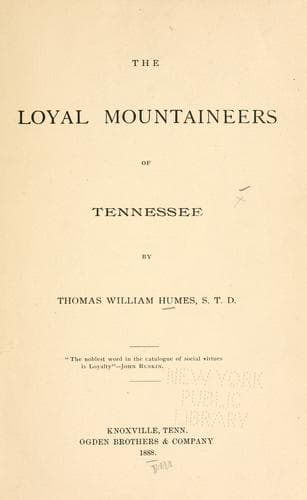
The loyal mountaineers of TennesseeHumes, Thomas William
Philosophy
The loyal mountaineers of Tennessee
Humes, Thomas William
Tennessee, East -- History -- Civil War, 1861-1865
After the battle of Fishing Creek, January, 1862, the buildings of
East Tennessee University were taken by the military for the lodging
of wounded men, and afterwards the Male Academy was turned by them
into a guard house. These diversions of school property to uses of
the army, seriously interfered of course with the work of educating
boys and young men. And yet the loss incurred in that way was not
very serious, because the number of students in the disordered state
of things had severely diminished. The army had absorbed some of the
older youth into its ranks, some borne on the fierce currents of
excitement, drifted off one way or another, and many were demoralized
from study by the abnormal social conditions. One of the University
professors had been for years a most successful teacher of boys. He
hailed from north of Mason and Dixon’s line, and before the secession
of Tennessee in June, 1861, had expressed his Union sentiments in
letters to friends who dwelt in the _taboo-ed_ region beyond the Ohio
River. As the State was then still in the Union, all letters from it
by mail should have been transmitted to their destination without
previous disclosure of their contents, but this was forbidden by
patriotic zeal for the Confederacy, to which the State was bound by
a military league. Of the intercepted communications to a distance
written by Union citizens, were some by the professor. Then there
went to him in writing anonymous threats of personal indignity and
injury, and the circumstances of the case appeared to justify the
fears they excited in him. After seeking judicious advice and not
being willing to contend with the wrath of his enemies, he shortly
departed for Ohio and left goods and chattels behind him, which were
afterwards seized and confiscated.
Another of the professors--a clergyman of the Presbyterian
Church--became an officer in the Confederate army. Another, who was
a native of the county, moved with fear of being forced to serve
in that army, and loving the Union, fled the country to Washington
and only returned upon the advent of Gen. Burnside into Knoxville.
The President of the University--a clergyman of the Protestant
Episcopal Church--thought that some such unwelcome advent would
occur in 1862. In the earlier part of that year, therefore, he made
a prudent arrangement with his associates to teach the few students
who remained until the session’s end, and departed for a quiet home
in North Carolina. Not long afterwards the doors of the institution
were closed to the work of education for four years. Schools for the
instruction of children continued in the town to a limited extent,
but their usefulness and success were lessened by the prevailing
anxieties and excitements.
Public-domain text, read in full here on John Shaqi.
Reviews
Reviews
No reviews yet
Be the first to share your thoughts on this work.
Elsewhere in the archive
Join the Discussion
Join the discussion
Sign in to leave a comment or review.
Sign InorCreate an account