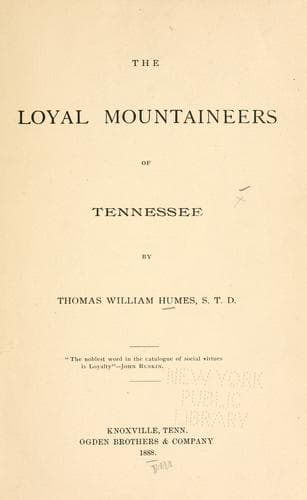
The loyal mountaineers of TennesseeHumes, Thomas William
Philosophy
The loyal mountaineers of Tennessee
Humes, Thomas William
Tennessee, East -- History -- Civil War, 1861-1865
in the war, that among those who attended upon his discourses were
men who in times of peace would not, because of their religious
prejudices, enter the door of a Roman Catholic Church.
Many citizens, because of their political sympathy or distrust of
the outcome, abstained from keeping actively along with the current
of affairs through 1862 into 1863, under the reign at the locality
of the Confederate Government. They merely subsided into quiet and
retirement. Deploring the country’s condition and observing the
progress of events with more or less interest, they yet gave their
thoughts and time to ordinary duties, content to await whatever
the future might develop. To people of truly Christian character,
the habitual surroundings of pageantry, clamors and clashes of war
were disagreeable: and for the promotion of a higher life in the
soul, they turned to seek “water out of the rock of flint.” Their
religious principles became firmer and stronger, and they themselves
more like their Master in the spirit of His mind. On the other hand,
the vicious and profane were emboldened to greater wickedness, and
the wicked dispositions of some could only be checked by military
discipline. It is not to be disputed also, that some professed
Christians were demoralized by the war and fell away from their
uprightness. History repeats itself. The results just named are like
those which have followed all great calamities to human society in
the form of civil wars, pestilences and famines.
Evidently a revolution had not only been attempted politically, but
was actually progressing in other respects. Its fruits thus far were
so ill and sour as to confirm the opinion of some that it had better
have been unborn or stifled in its birth; better that the evils
which it was proposed to remedy had been patiently borne with, and
so far as they really existed, peacefully removed. In the time to
come, its life might be short or long, and its consequences prove it
for better or worse, but one thing was certain: a most disagreeable
change of present conditions had occurred. Old things had been
displaced and new ones substituted. Citizens who preferred that the
former order were restored, found their hopefulness to that end beset
with discouragements. These very differently affected the minds of
Union men. All along the way since the spring of 1861, they had been
like an unorganized army retreating before a closely pursuing foe.
Sooner or later, some had weakened and fallen; some had turned aside
and lain down to sleep; some still trudged on, but lagged behind
their companions. And all these had previously made up their minds to
be captured. At length the number of staunch friends of the United
States left by refugees through the mountains was largely diminished.
Public-domain text, read in full here on John Shaqi.
Reviews
Reviews
No reviews yet
Be the first to share your thoughts on this work.
Elsewhere in the archive
Join the Discussion
Join the discussion
Sign in to leave a comment or review.
Sign InorCreate an account