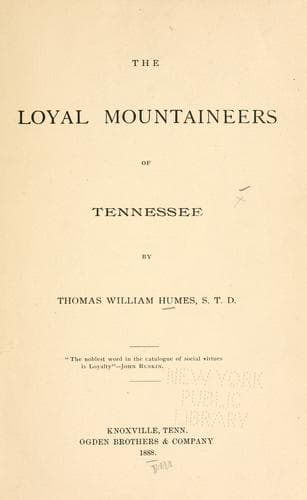
The loyal mountaineers of TennesseeHumes, Thomas William
Philosophy
The loyal mountaineers of Tennessee
Humes, Thomas William
Tennessee, East -- History -- Civil War, 1861-1865
In July, 1862, Gen. John H. Morgan, of Kentucky, who had considerable
fame as a partisan Confederate officer, having been defeated at
Lebanon, Tenn., reorganized his command and made Knoxville his
starting point for a new expedition. He passed into Kentucky,
capturing and destroying, engaged the Federals in battle at
Cynthiana, and at length withdrew from that State before a superior
force. One year later he again entered Kentucky from Sparta, Tenn.,
just west of the Cumberland Mountains, and went upon his well
known raid into Ohio and Indiana. Afterwards he again appeared in
East Tennessee, and one night, when asleep in a private dwelling,
exceptionally well provided, at Greeneville, he was surprised by a
party of United States soldiers. They had been informed as to where
he lodged, and in his attempt, partially dressed, to escape through
the garden of his hostess, a soldier fired upon and killed him.
The ordinary routine of things at Knoxville was enlivened in
the summer of 1862, by the arrival of some forty United States
soldiers who had been taken prisoners by Col. Forest, in the
military adventure and surprise he accomplished at Murfreesboro.
They bore their adversity with fortitude and unlessened devotion
to their country. Horses and wagons captured at the same time,
accompanied them and with the prisoners presented a spectacle of
military trophies that drew a crowd of triumphant beholders. Some of
these spectators made then their safe and nearest approach to the
destructive war, which they had rejoiced that others should carry
on with danger and hurt. The captured men were sent to Georgia. An
exhibition by authority--less creditable than the show of prisoners
and horses--was that of the private correspondence seized at
Murfreesboro, which was distributed the next day among soldiers and
citizens and read on the streets.
About the middle of August, 1862, Gen. Kirby Smith, having collected
forces sufficient for the purpose, made a forward movement into
Kentucky, crossing the mountains at a gap considerably west of that
named Cumberland. Soon after he departed, Col. W. M. Churchwell,
Provost Marshal, died of disease that was probably contracted through
exposure the previous winter at Cumberland Gap.
CHAPTER XII.
NEWS AND LITERATURE IN THE CONFEDERACY--A MIXED DINNER PARTY AND
ITS CONVERSATION--CARTER’S RAID AND WHAT BEFELL A RECRUITING
OFFICER--AN UNTERRIFIED YANKEE CITIZEN OF GEORGIA--SANDERS’
RAID--DEATH OF PLEASANT MCCLUNG.
“Young men soon give, and soon forget affronts;
Old age is slow in both.”
ADDISON’S _Cato_.
“A wise man ... examines if those accidents
Which common fame calls injuries, happen to him
Deservedly or no. Come they deservedly?
They are no wrongs then, but punishments:
If undeservedly and he not guilty,
The doer of them first should blush--not he.”
JONSON.
Public-domain text, read in full here on John Shaqi.
Reviews
Reviews
No reviews yet
Be the first to share your thoughts on this work.
Elsewhere in the archive
Join the Discussion
Join the discussion
Sign in to leave a comment or review.
Sign InorCreate an account