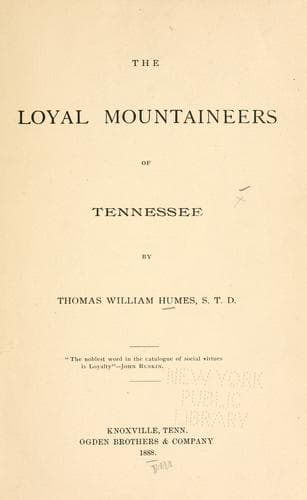
The loyal mountaineers of TennesseeHumes, Thomas William
Philosophy
The loyal mountaineers of Tennessee
Humes, Thomas William
Tennessee, East -- History -- Civil War, 1861-1865
At Williamsburg, a cavalry force under Col. Byrd, of the 1st
Tennessee Regiment, was detached for the purpose of making a
demonstration on Knoxville, by way of Big Creek Gap, and at
Montgomery a cavalry force was detached with orders to pass through
Winter’s Gap and occupy Knoxville. The main body of the command moved
on the direct road to Kingston, which point the advance reached on
the 1st of September. Col. Foster arrived at Knoxville September 2nd,
captured several engines and cars, which he sent up the railroad
to Morristown, Greeneville and near Jonesboro, and took also large
quantities of supplies. Little resistance was met with by the Federal
troops, throughout their entire march from Kentucky--the enemy in all
cases retreating before them. Their main body, with Gen. Burnside
in person, moved forward from Kingston and reached Knoxville on the
3rd. In his opinion, “nothing could be better than the conduct of
the officers and men of the Twenty-third corps; from the time it
left Kentucky, their labors were most difficult, but were performed
with the greatest accuracy and efficiency.” The mountainous route
by which the army traveled was long and fatiguing, but it was the
only one possible. At the end of the journey the army was, he said,
“in the midst of friends;” it “found the people generally loyal and
disposed to do all in their power for its comfort and welfare.” At
the same time it was more than two hundred miles from the Ohio River,
and one hundred and fifty miles from the nearest point where the
mountains and ridges that traverse Southeastern Kentucky give place
to the fertile and garden-like “blue-grass region.” From beyond those
highlands, supplies for the army must be transported in wagons drawn
by mules, whose mongrel nature, hardy as it is, was so unequal to
the roughness and toil it had to bear in the work of transportation,
that the number of their dead bodies lying on sides of the road over
the mountains might be named Legion. It was currently estimated,
as aggregating from first to last, ten thousand. Although the army
occupied Knoxville and other important points in East Tennessee, it
had not exclusive possession of that region. The great body of the
population was friendly, but there were hostile troops in several
directions.
Public-domain text, read in full here on John Shaqi.
Reviews
Reviews
No reviews yet
Be the first to share your thoughts on this work.
Elsewhere in the archive
Join the Discussion
Join the discussion
Sign in to leave a comment or review.
Sign InorCreate an account