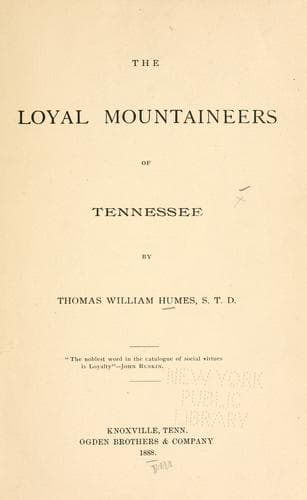
The loyal mountaineers of TennesseeHumes, Thomas William
Philosophy
The loyal mountaineers of Tennessee
Humes, Thomas William
Tennessee, East -- History -- Civil War, 1861-1865
It may easily be seen that it was impossible that the obedience
promptly given by Burnside to Halleck’s order, could avail in helping
Rosecrans, as intended. The United States troops, which were in
the upper country of East Tennessee, according to instructions
before given to Burnside, were from 150 to 200 miles distant from
Chicamauga, where Rosecrans was to do battle, and they could not
travel so far in the very short time before that battle began,
even if they were moved towards the spot as rapidly as possible.
Afterwards, when Rosecrans had established himself in Chattanooga,
many dispatches passed between Halleck and Burnside, in reference
to the latter’s going to strengthen and assist Rosecrans, and
some misunderstandings occurred in regard to the purport of those
dispatches. Gen. Burnside, in his report to the War Department, gives
the underlying reason. He says: “I was averse to doing what would
in any way weaken our hold in East Tennessee, and he (Halleck) was
anxious lest Rosecrans should not be able to hold Chattanooga. He
(Rosecrans) was not disturbed at Chattanooga, and we held our ground
in East Tennessee, so that what occurred in no way affected the
result.”
By the 30th of September, the whole of the Ninth army corps
arrived, numbering about 6,000 men. Previous to that date, Gen.
White’s division had been sent to Loudon, Col. Woolford’s cavalry
had reinforced Col. Byrd, and they were instructed to connect with
Rosecrans’ cavalry; Gen. Carter held Bull’s Gap, which was then the
most advanced position of the United States troops up the valley,
and Col. Haskell was in support at Morristown. Many of the men were
suffering from want of clothing, for there was great difficulty
in getting sufficient supplies across the mountains, and the
temperature of the air was frosty. On October 5th, Gen. Wilcox
arrived at Cumberland Gap with four new regiments of Indiana troops.
He was ordered to Morristown, and thence to Bull’s Gap, and to him
Col. Haskin’s brigade was directed to report from Morristown. Gen.
Burnside had determined to push his advance farther up the valley,
and with this purpose he sent the Ninth corps, under Brig. Gen., R.
B. Potter, in that direction, together with all the cavalry under
Gen. Shackelford, except Byrd’s and Woolford’s brigades. A junction
of all these forces was made at Bull’s Gap, where Gen. Burnside
arrived in person on the 9th, and on the following morning an
advance movement was ordered. At Blue Springs, between Bull’s Gap
and Greeneville, the enemy was found in heavy force and in a strong
position between the wagon road and the railway to Greeneville. The
United States cavalry occupied him in skirmishing until late in the
afternoon. Col. Foster was sent, with instructions to establish
his brigade in the rear of the enemy, on the line over which the
latter would be obliged to cross in retreating, and at a point near
Rheatown. An attack from the front was delayed until sufficient time
Public-domain text, read in full here on John Shaqi.
Reviews
Reviews
No reviews yet
Be the first to share your thoughts on this work.
Elsewhere in the archive
Join the Discussion
Join the discussion
Sign in to leave a comment or review.
Sign InorCreate an account