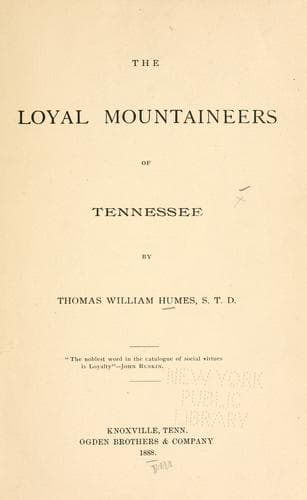
The loyal mountaineers of TennesseeHumes, Thomas William
Philosophy
The loyal mountaineers of Tennessee
Humes, Thomas William
Tennessee, East -- History -- Civil War, 1861-1865
The United States General who was the intended victim of that
undertaking was not blind to the possibility that his military
occupation of East Tennessee would shortly be brought to an end by
a hostile force from the southwest. The bare thought of such an
event deeply grieved him, not only as a disaster to the Federal
Government, but also as a great calamity to the Union people of East
Tennessee. A short time before Longstreet’s march upon Knoxville
began, Burnside in private conversation with a citizen-friend, spoke
with strong feeling of the possibility that he would not be able
to continue to those people his protection. Had they known that not
without reason he thought such a contingency existed, they would
have been as deeply pained as he was, at the idea of his departure.
He had been among them only about ten weeks, but in that brief time
he had won their hearts. He had made good use of his opportunities
to establish the military supremacy of the United States, to extend
its area in East Tennessee and to hold it in possession against
enemies. He had also, without putting aside the dignity becoming his
official position, manifested the kindly sympathy he sincerely felt
for the Union people who had suffered for more than two years under
Confederate rule, he had permitted a healthy freedom of approach
to his presence, had listened when at leisure to their griefs and
wrongs, had now and then, as his public duties permitted, partaken
of their hospitalities, and in a word, had in various ways showed
that he was their friend. Everywhere he was looked upon with respect
and affection. Even among citizens, at heart hostile to the flag he
defended, were some who admired and liked him. They could not well be
otherwise than content with him, for he visited them with no needless
severities and his judgments were reasonable. His native magnanimity
of soul would have lifted him above seeking revenge for his private
wrongs suffered from the conflict, but he had no such wrongs. The
bitterness and animosities which he found the war had produced among
neighbors in East Tennessee, met with no favorable response from his
own heart. He could not fully understand them, and spoke of their
existence with mingled surprise and regret.
Public-domain text, read in full here on John Shaqi.
Reviews
Reviews
No reviews yet
Be the first to share your thoughts on this work.
Elsewhere in the archive
Join the Discussion
Join the discussion
Sign in to leave a comment or review.
Sign InorCreate an account