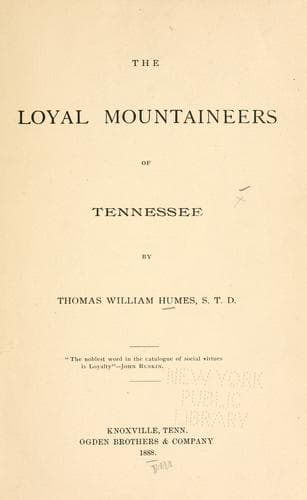
The loyal mountaineers of TennesseeHumes, Thomas William
Philosophy
The loyal mountaineers of Tennessee
Humes, Thomas William
Tennessee, East -- History -- Civil War, 1861-1865
issue, official reports to receive, and troops to be sent here and
there. Sometimes Union citizens, overflowing with patriotic zeal, had
news to tell at headquarters, which they thought to be important.
If now and then their zeal outstripped their discretion, it was
little wonder that the information they carried should be lacking
in accuracy. No doubt such instances of unintentional but hurtful
mistakes were rare, for military life and discipline forbade their
repetition even by civilians. One case was visited with a reprimand
to the offender that was justly severe upon him and amusing to others.
Late one night a strong partisan interrupted the serenity at
headquarters with the exciting statement that the Confederates had
marched upon Maryville, in Blount County, 17 miles distant, where
were only a few United States soldiers. Quickly a sufficient body
of cavalry were summoned from their beds into their saddles and
dispatched to repel the invading force. The alarm proved to be false;
no Confederate troops were found in or near Maryville. The next day.
General Burnside, on meeting his deceived and deceiving informant,
said to him, “Mr. ----, you bring me a great deal of news. Now, I
don’t want you to bring me any more, for _the average is bad_!”
It has been said that all religion springs from a sense of
dependence upon the Supreme Being. We may doubt the truth of the
postulate, but certainly all true religion includes that sense,
and it had its proper place in the mind of Gen. Burnside. While
his personal and social conduct in East Tennessee was upright and
blameless, he was not forgetful of Him who “doeth according to His
will in the army of heaven and among the inhabitants of the earth,”
and to thoughts of whom, the responsibilities of his position, its
difficulties and dangers tended to move him more actively. He once
said to a friend during that period, that he “loved sometimes to
retire to his own room, there to lift up his mind and heart to God,
and to give himself to quiet meditation.” The impression made by his
conversations, his reverent participation in the worship of God and
hearing of the gospel, was that without much knowledge of religious
doctrine, he accepted in faith the truth of Christianity.
Immediately after his first arrival at Knoxville, Burnside sent to a
certain Christian minister, who because of his Union sentiments had
been excluded for precisely two years from his pastoral charge, a
written invitation to fill the unoccupied pulpit of his own church
on the next Sunday. The request was complied with--the day being
the 6th of September. By one of those curious coincidences which
have been noticed to occur at different times in similar religious
services, when the portion of the Psalms for that morning came to be
responsively read, the minister unexpectedly to himself and to the
surprised attention of some in the congregation who knew all the
facts of the case, began, as prescribed, with the words:
Public-domain text, read in full here on John Shaqi.
Reviews
Reviews
No reviews yet
Be the first to share your thoughts on this work.
Elsewhere in the archive
Join the Discussion
Join the discussion
Sign in to leave a comment or review.
Sign InorCreate an account