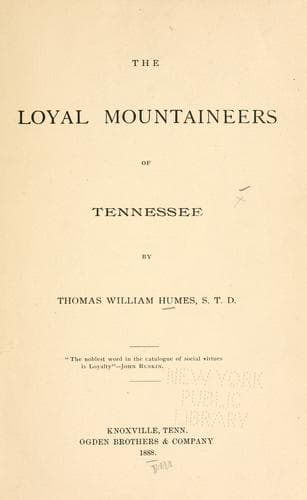
The loyal mountaineers of TennesseeHumes, Thomas William
Philosophy
The loyal mountaineers of Tennessee
Humes, Thomas William
Tennessee, East -- History -- Civil War, 1861-1865
Not the least trying quality in the existing condition to the minds
of Union people, was the uncertainty of the result, so full to
them of weal or woe. Their anxiety was lessened by emulating the
confidence of the soldiers in Burnside. As for any quiet reflection
upon probabilities, they had little or no opportunity to indulge in
it. Even the returning hours of darkness did not bring stillness. The
night of November 28th was especially disturbed. The noise from the
fighting near Fort Sanders for two hours about midnight, was followed
by cannonading from Longstreet, which shook the frailer houses of
citizens and broke their sleep into fragments. Before 6 o’clock next
morning, people looking westward from upper windows, could see the
flashing of artillery on the river bluff beyond College Hill, which
accompanied
THE ASSAULT UPON FORT SANDERS.
Its garrison consisted of Benjamin’s battery, part of Buckley’s, and
portions of both the 79th New York and the 2nd Michigan volunteer
infantry. The fort itself was a bastioned earthwork, built upon an
irregular quadrilateral, fronting 125 yards each, on the north and
south, 95 yards on the west and 85 yards on the east. The last named
front was left open--to be afterwards stockaded; the southern front
was about half and the northern nearly finished, and the one on the
west was entirely so, except cutting the embrasures. The bastion
angles were very heavy, the relief of the lightest one being 12 feet.
The ditch of the fort was 12 feet wide and from 7 to 8 feet deep. On
the parapet were laid bales of cotton, which a covering of wet hides
prevented from ignition by the cannon.
The whole command of Gen. Burnside were on the alert during the
night. Especially so was Lieut. Benjamin, with his two hundred
and twenty men under orders to keep strict silence. Just as the
sun rose, the National flag was unfurled above the fort, and as
the music of the “Star-spangled Banner” was poured forth at the
same moment by the Division band, the voices of the men also went
up in cheer after cheer. Then the enemy began a furious fire from
batteries on the north and west, 700 and 1500 yards distant, and
from the battery across the river. This cannonading lasted for
twenty minutes, injuring only one man, but it met with no reply from
Burnside’s batteries. Immediately a fire of musketry was opened by
Longstreet, and at the same time a heavy column of troops, which he
had concentrated in the night upon the ridge about 80 yards from the
bastions, charged on them under cover of a fog, at a run. His order,
issued after midnight, through Maj. Gen. McLaws, was as follows:
HEADQUARTERS, Nov. 29, 1863.
Public-domain text, read in full here on John Shaqi.
Reviews
Reviews
No reviews yet
Be the first to share your thoughts on this work.
Elsewhere in the archive
Join the Discussion
Join the discussion
Sign in to leave a comment or review.
Sign InorCreate an account