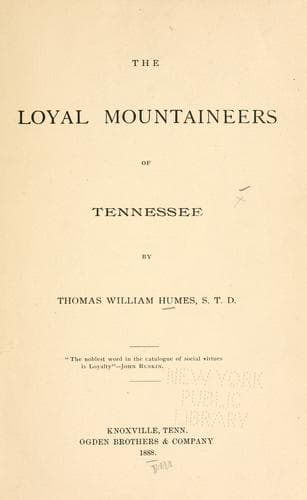
The loyal mountaineers of TennesseeHumes, Thomas William
Philosophy
The loyal mountaineers of Tennessee
Humes, Thomas William
Tennessee, East -- History -- Civil War, 1861-1865
Mr. Taylor was known to be a Union man, and therefore could not be
permitted to dwell peacefully at home with his wife and children. He
was arrested and tried by a drum-head court-martial as an accomplice
in the bridge-burnings of 1862, but was acquitted. Afterwards, being
threatened with arrest and imprisonment upon the charge of High
Treason against the Confederacy--to end, perhaps, in his death--he
sought refuge in secluded and very inaccessible gorges of the
mountains. His concealment there was attended with privations, but it
disconcerted enemies in their pursuit. Upon learning of Burnside’s
advent into East Tennessee, he became perplexed in mind as to his
personal duty. He could not remain in his hiding place without
danger of being discovered and hunted from it, if not seized. The
Confederate troops were between him and Burnside at Knoxville, and
he could reach there only with difficulty and risk. If he attempted
to do so and succeeded, in what way under the protection of friendly
power, could he best serve his country? He almost determined to seek
for a suitable position in the United States army, but postponing a
conclusion, he submitted the subject to God in prayer. Upon doing
this, he was persuaded that his petition for guidance and direction
was answered by the strong impression of a new idea upon his mind.
For some time he had been deeply moved at heart, in his daily and
nightly reflections, by a vision which the unhappy condition of East
Tennessee suggested; a vision of famine and death swiftly coming
upon its people. Prayer in faith had been the means of opening his
eyes as to what he should do in relation to those impending evils.
He thought that the Spirit of the Lord spoke to his own spirit:
“Your duty is to go and tell the people of the North, of this
great, threatening destitution, that they may interpose with their
beneficence between it and the suffering people of East Tennessee.”
He accepted the conclusion as from Him who inspires those who trust
in Him to all good and praiseworthy undertakings. Escaping at once
through the Confederate lines to Knoxville, he proceeded from thence
to Cincinnati upon his humane and patriotic mission. There he met
with sympathizing friends of his enterprise, to promote which several
hundred dollars were contributed by citizens, after a public meeting
had been held and an address heard from him. The amount would have
been larger, had there not been already a stream of needy refugees
from the seceded States to Cincinnati and other points on the Ohio
River, which two months later grew into “great numbers.” To provide
for that out-flow of “thousands of women, children and aged men--all
meanly clad, well-nigh starved, and many well-nigh heart-broken,” the
Refugee Relief Commission was established at Cincinnati.
Public-domain text, read in full here on John Shaqi.
Reviews
Reviews
No reviews yet
Be the first to share your thoughts on this work.
Elsewhere in the archive
Join the Discussion
Join the discussion
Sign in to leave a comment or review.
Sign InorCreate an account