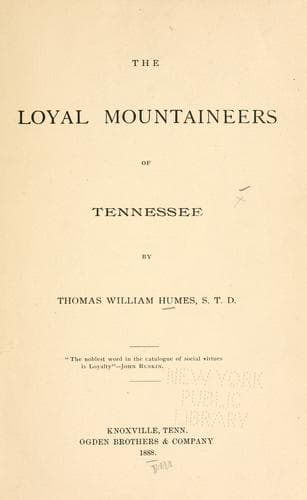
The loyal mountaineers of TennesseeHumes, Thomas William
Philosophy
The loyal mountaineers of Tennessee
Humes, Thomas William
Tennessee, East -- History -- Civil War, 1861-1865
Dr. Ramsey’s history repeats the narrative in MS. of one who lived at
that time. He tells that four of the six men above named concealed
themselves outside the town, while Cozby and Evans went into it
and entered the crowd attracted to the scene by the prisoner’s
fame. Evans, apparently an unconcerned visitor, led Sevier’s horse,
(celebrated for swiftness,) in front of the Court house, and threw
the bridle carelessly over its neck. Cozby went into the house, and
his eyes met those of the prisoner. Sevier at once knew that rescue
was at hand, but a sign from Cozby restrained him. There was a pause
in the trial. Cozby stepped forward in front of the Judge and asked
him with quickness and energy: “Are you done with that man?” His
hearers were startled and wondering, and while their attention was
turned aside, Sevier sprang to the door, then to the saddle on the
waiting horse and speedily was gone. He was followed by his rescuers
and welcomed by the two friends who were without the town. Then, away
the whole party went homeward, leaving their pursuers hopelessly
behind.
There have been recent publications concerning Sevier, in which his
antagonist, Tipton, has been spoken of unfavorably. J. C. Tipton, an
aged grandson of Col. John Tipton, has been moved to publish, that
there are two errors in current history of that early period. One of
these is in the statement that Tipton would have hung Sevier’s sons,
his prisoners, but was persuaded by friends to spare their lives.
The second error, relates to Sevier’s deliverance from captivity.
Mr. Tipton affirms that “Col. Tipton started Gov. Sevier to North
Carolina for trial under a guard of two men, that Sevier escaped
in the mountains on the way, and was not taken to Morganton.” He
represents that these facts were received by him from his father,
Jonathan Tipton, to whom they were communicated by Col. John Tipton.
He admits that the errors of which he writes, should have met long
since with correction, but the general character of both Tipton and
Sevier having been that of “honorable, brave and magnanimous men,”
the necessity for it sooner has not seemed urgent. The historical
revival of the subject now invites this act of justice to the memory
of his ancestor.
APPENDIX: NOTE C: Page 88.
The following letter to the author of these Reminiscences, is
from his friend,--a gentleman of superior social and professional
standing, and a citizen of Richmond, Virginia. It expresses his mind,
and probably that of many other intelligent and reflecting persons
in Virginia at the time it was written, concerning the civil and
political situation.
RICHMOND, Dec. 26, 1860.
“There are times when friends are indeed blessings. I prize a
sympathizing friend more and more every day: and I almost think
that the time has come when union with Christ is the only bond
that can certainly survive the shock and the disintegration that
threaten our social structure.
Public-domain text, read in full here on John Shaqi.
Reviews
Reviews
No reviews yet
Be the first to share your thoughts on this work.
Elsewhere in the archive
Join the Discussion
Join the discussion
Sign in to leave a comment or review.
Sign InorCreate an account