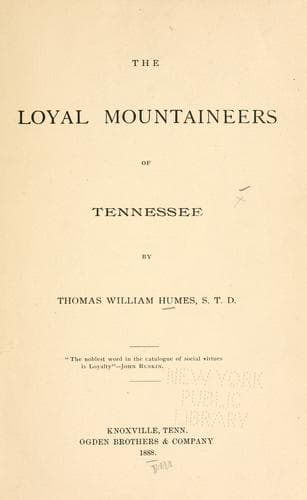
The loyal mountaineers of TennesseeHumes, Thomas William
Philosophy
The loyal mountaineers of Tennessee
Humes, Thomas William
Tennessee, East -- History -- Civil War, 1861-1865
Plentiful heroes from this War will spring,
With praise of whom shall Fame’s proud arches ring,
And unborn generations with pains be taught,
At mother’s knee and school, what deeds they wrought.
But thou, as Jupiter excels in light
Planets and stars which deck the robe of night,
Shalt for thy courage and milit’ry skill
Above compeers, historic pages fill.
They have won battles,--strong batteries storm’d,
And such small deeds, common in War, perform’d:
But thou, with soaring aim, hast hung three men,
Sentenced by Martial Court and thy brave pen.
These loved their country; one, in prime of life
Bequeathed it all he had, children and wife;
The second, gray with age, the third, his son,
Whom thou didst order,--by no pity won,
Should to life’s closing scene together go,
And while one died, the other see his woe!
Brave General! goodness ever is allied
With greatness. Be thou, thy country’s pride!
APPENDIX: NOTE K: Page 167.
NARRATIVE BY EDWARD J. SANFORD OF KNOXVILLE, TENN.
In February, 1862, the Rebel Conscript Law was enacted in Tennessee
declaring every man between the ages of eighteen and forty-five
a soldier of the Southern Confederacy, and the then Governor, I.
G. Harris, made a call for the entire militia force of the State.
Consequently the prospect of being speedily compelled to do battle
against their sense of right and justice, added to the already
precarious condition of those citizens who were known to entertain
Union sentiments, and many companies of Union men were formed in East
Tennessee for the purpose of running through the rebel lines and
joining the Federal army in Kentucky.
For several days previous to April 18, 1862, such a company was
forming in Knox and Blount counties. Guides were procured who knew
the mountain paths and who were constantly passing to and from the
Federal camp in Kentucky. For the ostensible purpose of buying beef
in the mountain region for the Confederate army, passes were procured
by men who employed their time in preparing a boat on the Clinch
river about twenty miles north of Knoxville and secreting it from the
watchful eyes of rebel pickets, so that the company could be set over
without delay.
Public-domain text, read in full here on John Shaqi.
Reviews
Reviews
No reviews yet
Be the first to share your thoughts on this work.
Elsewhere in the archive
Join the Discussion
Join the discussion
Sign in to leave a comment or review.
Sign InorCreate an account