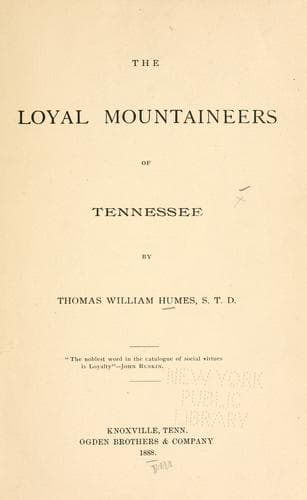
The loyal mountaineers of TennesseeHumes, Thomas William
Philosophy
The loyal mountaineers of Tennessee
Humes, Thomas William
Tennessee, East -- History -- Civil War, 1861-1865
A junction of the forces (consisting of two battalions 2nd Michigan
Cavalry, Lieut. Col. Campbell; the 9th Pennsylvania Cavalry, Major
Russell; and one battalion 7th Ohio Cavalry. Major Raimey) was made
near the mouth of Goose Creek, Clay County, Kentucky. As ordered by
Gen. Burnside, Col. Charles J. Walker of the 10th Kentucky Cavalry
was placed in command of the cavalry brigade.
The troops were ordered to move without baggage, with ten days
rations, and 100 rounds of ammunition; but as it was feared some
difficulty would be met with in obtaining forage, a supply train
was ordered to proceed some 60 miles on the route and then transfer
forage and rations to a train of pack mules. On the 22nd December
Gen. Carter, who left Lexington on the 20th, came up with the two
battalions of the 2nd Michigan and the 9th Pennsylvania at McKee,
Jackson county, Kentucky, and after one day’s necessary detention,
they effected a junction on the 26th with the remainder of the
troops, (1st Battalion of 7th Ohio Cavalry) at Heard’s on Goose
Creek. The whole force amounted only to about 1,980 men, and of that
number a considerable portion were in the field for the first time.
The marches, owing to the roughness and narrowness of the roads,
(being merely bridle paths along the banks of creeks and over steep
and rugged mountains) were of necessity slow and tedious, and their
length had to be governed by the distance to the several points at
which forage could be obtained. It was not until about meridian of
the 28th, that they reached the foot of the Cumberland mountain (on
the north side,) opposite “Crank’s Gap,” 12 miles to the southward
and eastward of Harlan Court House. The pack train was sent back in
charge of a detachment of the Kentucky State Guard.
A little before sunset they reached the summit of the Cumberland
mountain, and had the field of their operations, with its mountains
and vallies spread out before them. Gen. Carter then consulted with
the officers of his command, and it was the unanimous opinion that
the force was entirely too small to venture on a division according
to the original plan. This decision seemed to be the more necessary
from the news they had received through East Tennessee refugees at
the foot of the mountain, relative to the disposition of the rebel
forces along the line of the railroad.
Public-domain text, read in full here on John Shaqi.
Reviews
Reviews
No reviews yet
Be the first to share your thoughts on this work.
Elsewhere in the archive
Join the Discussion
Join the discussion
Sign in to leave a comment or review.
Sign InorCreate an account