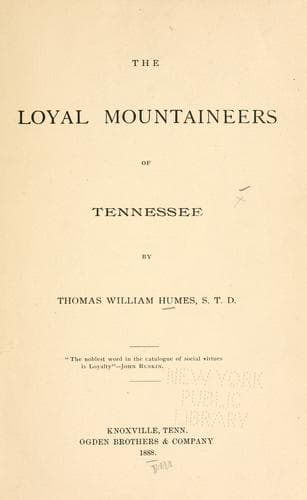
The loyal mountaineers of TennesseeHumes, Thomas William
Philosophy
The loyal mountaineers of Tennessee
Humes, Thomas William
Tennessee, East -- History -- Civil War, 1861-1865
“On the north bank of the river, a narrow ridge is formed,
extending from a point about two and a-half miles east of
Knoxville, to Lenoir’s. It has an average base of about one and
a-half miles in width. At Knoxville, the width is about one mile.
This ridge is cut through at short intervals by small streams,
two of which, First and Second creeks, run through the town of
Knoxville at a distance from each other of about three-fourths
of a mile. The main part of the town is built upon that portion
of the ridge bounded on the northwest by the valley, on the
southwest by Second Creek, on the southeast by the Holston River
and on the northeast by First Creek. It has the appearance of
a table, elevated about 150 feet above the river, and about
100 feet above the valley. Again, Third Creek is found about
seven-eighths of a mile below Second Creek, forming a second
similar table. A depression in the ridge about the same distance
east of First Creek, forms still another table upon which is
built East Knoxville. This elevated ground is called Temperance
Hill. From this eastward, the ridge is more broken until it
disappears and other ridges spring up. This last division is
known as Mabry’s Hill, and is the highest ground by some twenty
feet to be found on the north side of the river within cannon
range of Knoxville.”
CAPTAIN O. M. POE,
Chief Engineer, Dept. of the Ohio.
APPENDIX: NOTE U: Page 282.
Gen. Sherman found on Gen. Burnside’s table such a good dinner, that
he exclaimed at its contradiction of statements he had heard, that
the besieged army was starving. Gen. Burnside explained that he had
access to supplies from farmers on the south side of the river. No
doubt the dinner was exceptional in the family and had been provided
at extra pains, in honor of the guest. Had he shared the rations of
the soldiers during the siege, he could have verified the reported
scarcity.
The Comte de Paris seems to have read between the lines of Gen.
Sherman’s Memoirs, for he represents that “Gen. Sherman relates his
astonishment when entering a place (Knoxville) which he believed
to be reduced to the last extremities, he beheld a park of the
finest cattle, and when afterwards, Burnside bade him sit down to
a table abundantly served, he understands that the peril has been
exaggerated.” (History of the Civil War in America: By the Comte de
Paris, Vol. IV., page 329.)
The Count is here distressingly inaccurate. Gen. Sherman does not say
that at Knoxville he beheld a park filled with the finest cattle. He
could not have done so, for they were not there to be seen. The “park
and the finest cattle” are figments of the imagination.
APPENDIX: NOTE V: Page 285.
Will H. Brearley of Michigan quotes from a letter written by Col. E.
P. Alexander, Chief Engineer of Gen. Longstreet, dated October 18,
1870, as follows:
Public-domain text, read in full here on John Shaqi.
Reviews
Reviews
No reviews yet
Be the first to share your thoughts on this work.
Elsewhere in the archive
Join the Discussion
Join the discussion
Sign in to leave a comment or review.
Sign InorCreate an account