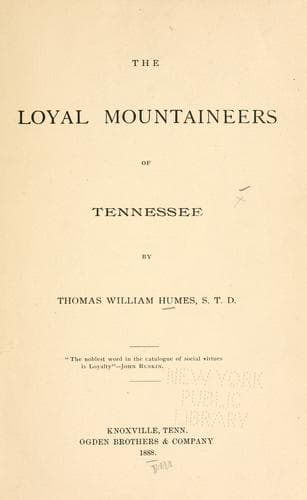
The loyal mountaineers of TennesseeHumes, Thomas William
Philosophy
The loyal mountaineers of Tennessee
Humes, Thomas William
Tennessee, East -- History -- Civil War, 1861-1865
Yancey, Wm. L., 81-85
Zolicoffer, Gen. Felix, 122-126, 131, 139, 153, 163
FOOTNOTES:
[1] Two Brothers Hare--in “_Guesses at Truth_.”
[2] Bancroft. Ch. XLVI.: Ed. 1854.
[3] “A Brief Historical, Statistical and Descriptive Review of
East Tennessee, Developing its Immense Agricultural, Mining and
Manufacturing Advantages. By J. Gray Smith.” ... London, 1842.
[4] Its population was 301,056 in 1860, and 428,929 in 1880.
[5] See Appendix: Note A.
[6] Mr. Balestier.
[7] In 1887 East Tennessee voted in favor of a State prohibition law
by a majority of nearly 13,000.
[8] The mountaineers are innocent of the dialect given them in recent
novels.
[9] Moses White, Esq., in an address to the Tennessee Press
Association, has made these historical statements.
[10] See letter of “Gath” (George Francis Townsend)--Cincinnati
Enquirer, September, 1885.
[11] Hon. Henry R. Gibson.
[12] “History of the Battle of King’s Mountain,” by Dr. Lyman C.
Draper: (the fruit of laborious historical research, and exhaustive
of its subject.)
[13] Dr. Ramsey writes, “Dupoister.”
[14] Haywood’s History of Tennessee: Knoxville, Tenn., 1821. 8vo.
[15] See Appendix: Note B.
[16] See Appendix, Note C.
[17] Note D.
[18] See Appendix: Note E.
[19] See Appendix Note F.
[20] See Appendix: Note G.
[21] See Appendix Note H.
[22] A Union man, who was also an elder of a Presbyterian Church,
was grieved to hear its bell joining with merriest notes in the
chorus of song. He sought with speed to know the reason, and found a
citizen of good social position, whose intimate relations were more
with this present world than with that which is to come, had got into
the Church by a window, and was vigorously applying his gentlemanly
muscle on the rope that led to the steeple.
[23] See Appendix: Note I.
[24] He died in prison.
[25] See Appendix Note J.
[26] NOTE.--The youthful officer was soon after killed in battle for
the Confederacy.
[27] See Appendix: Note K.
[28] See Appendix Note L.
[29] See Note M.
[30] See Appendix: Note N.
[31] See Notes O. and P.
[32] See “A Rebel War Clerk’s Diary at the Confederate States
Capital,” Vol. 2, page 46.
[33] NOTE.--The Comte de Paris charges “guilty neglect” upon Foster:
that while he halted his column under the pretext of allowing his
men time to rest, he sent on the road to Henderson’s Mill the Fifth
Indiana Regiment, through which the Confederate troops easily opened
a way.--_The Civil War in America, Vol. 4._
[34] Gen. Grant, in his “Personal Memoirs” (see Vol. II., page 49)
puts the force with which Longstreet left Chattanooga “to go against
Burnside at about fifteen thousand troops, besides Wheeler’s cavalry,
five thousand men.” For Longstreet’s mind as to the situation, see
Appendix, Note R.
Public-domain text, read in full here on John Shaqi.
Reviews
Reviews
No reviews yet
Be the first to share your thoughts on this work.
Elsewhere in the archive
Join the Discussion
Join the discussion
Sign in to leave a comment or review.
Sign InorCreate an account