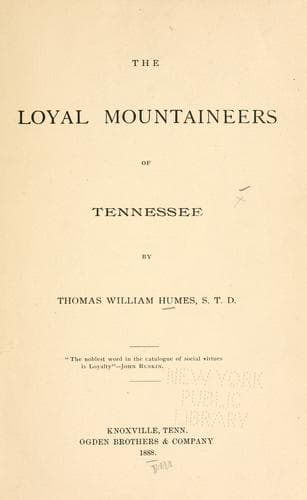
The loyal mountaineers of TennesseeHumes, Thomas William
Philosophy
The loyal mountaineers of Tennessee
Humes, Thomas William
Tennessee, East -- History -- Civil War, 1861-1865
It should be remembered that these things were spoken and done, not
in a corner, but in the broad light and open air, and under the
intimidating influence of hostile soldiers close at hand. They rode
along the highway in sight of the convention and shouted at it their
defiance and scoffs; but without otherwise molesting it.
THE CONVENTION IN GREENEVILLE
Was held nine days after the election, which was declared to be
in favor of secession. It met on the 17th of June, according to
adjournment from Knoxville on the 31st of May. The delegates present
numbered two hundred and ninety-two, from twenty-six counties: four
other counties being represented by proxies. The change of place
greatly diminished the attendance from some counties and increased
it from others.[21] The general committee appointed at Knoxville
was continued with some changes, chiefly to supply absences; its
new members being W. B. Carter, of Carter; Jas. W. Deaderick,
of Washington; R. L. Stanford, of Sullivan; John Netherland, of
Hawkins; Jas. P. Swann, of Jefferson; Charles F. Barton, of
Hancock; W. B. Staley, of Roane; J. Stonecipher, of Morgan; L. C.
Houk, of Anderson; J. A. Cooper, of Campbell; R. K. Byrd, proxy for
Cumberland; Wm. M. Biggs, of Polk; J. G. Spears, of Bledsoe; S. C.
Honeycutt, proxy for Scott; and E. S. Langley, for Fentress.
On the second day the committee recommended to the convention, a
Declaration of Grievances with Resolutions, which were discussed
and finally adopted. In these were set forth at greater length
their sentiments and the reasons for them, than were in the similar
document at Knoxville.
The Declaration affirmed that so far as the convention could learn,
the election held in Tennessee on the eighth of June “was free
with but few exceptions, in no part of the State other than East
Tennessee. In the larger parts of Middle and West Tennessee, no
speeches or discussions in favor of the Union were permitted. Union
papers were not allowed to circulate. Measures were taken in some
parts of West Tennessee, in defiance of the Constitution and laws
which allow folded tickets, to have the ballots numbered in such
manner as to mark and expose the Union votes.... Disunionists in
many places had charge of the polls, and Union men when voting were
denounced as Lincolnites and Abolitionists. The unanimity of the
votes in many large counties, where but a few weeks ago the Union
sentiment was so strong, proves beyond doubt that Union men were
overawed by the tyranny of the military power and the still greater
tyranny of a corrupt and subsidized press.... For these and other
causes we do not regard the result of the election as expressive of
the will of a majority of the freemen of Tennessee. Had the election
been conducted as it was in East Tennessee, we would entertain a
different opinion.”
Public-domain text, read in full here on John Shaqi.
Reviews
Reviews
No reviews yet
Be the first to share your thoughts on this work.
Elsewhere in the archive
Join the Discussion
Join the discussion
Sign in to leave a comment or review.
Sign InorCreate an account