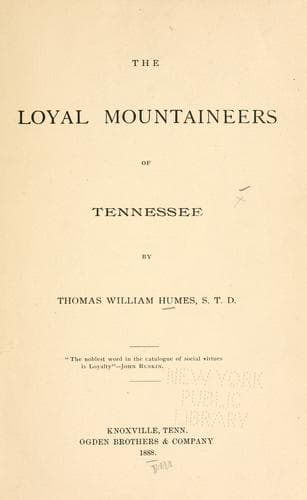
The loyal mountaineers of TennesseeHumes, Thomas William
Philosophy
The loyal mountaineers of Tennessee
Humes, Thomas William
Tennessee, East -- History -- Civil War, 1861-1865
SIR--Your report of the 20th instant is received, and I now
proceed to give you the desired instruction in relation to
the prisoners of war taken by you among the traitors of East
Tennessee.
First. All such as can be identified in having been engaged
in bridge-burning are to be tried summarily by drum-head
court-martial, and, if found guilty, executed on the spot by
hanging. It would be well to leave their bodies hanging in the
vicinity of the burned bridges.
Second. All such as have not been so engaged are to be treated
as prisoners of war, and sent with an armed guard to Tuscaloosa,
Alabama, there to be kept imprisoned at the depot selected by the
Government for prisoners of war.
Whenever you can discover that arms are concentrated by these
traitors, you will send out detachments, search for and seize the
arms. In no case is one of the men, known to have been up in arms
against the Government to be released on any pledge or oath of
allegiance. The time for such measures is past. They are all to
be held as prisoners of war, and held in jail to the end of the
war. Such as come in voluntarily, take the oath of allegiance and
surrender their arms, are alone to be treated with leniency.
Your vigilant execution of these orders is earnestly urged by the
Government.
Your obedient servant,
(Signed) J. P. BENJAMIN,
Secretary of War.
COL. W. B. WOOD, Knoxville, Tenn.
P. S.--Judge Patterson Andy Johnson’s son-in-law, (Rem.
Corresp.), Col. Pickens and other ring-leaders of the same class,
must be sent at once to Tuscaloosa to jail as prisoners of war.
The Hon. W. H. Humphreys had been on the Bench of the United States
District Court before Tennessee seceded. He had warmly espoused
the cause of the Southern Confederacy and was appointed by it to
a similar office under its Government. As preliminary to his new
duties, he announced from the Bench his determination to punish all
treason and rebellion against the authority he represented. Union
men were arraigned before him upon various charges. The only crime
of a majority of them was love of the Union. For their political
purgation, an oath of allegiance was thought to be sufficient, and
upon taking it they were summarily released.
The compulsory swearing of fealty during the progress of the war
had in many instances a demoralizing effect. It made familiar to
men the idea of an oath as having in itself no binding force, and
therefore tended to increase the lenient regard which was before too
prevalent for the crime of perjury. No doubt an oath of allegiance
was administered to many men on both sides of the conflict, under
compulsion of their wills, who in their hearts considered it null and
void. They felt as Hudibras puts it:
Public-domain text, read in full here on John Shaqi.
Reviews
Reviews
No reviews yet
Be the first to share your thoughts on this work.
Elsewhere in the archive
Join the Discussion
Join the discussion
Sign in to leave a comment or review.
Sign InorCreate an account