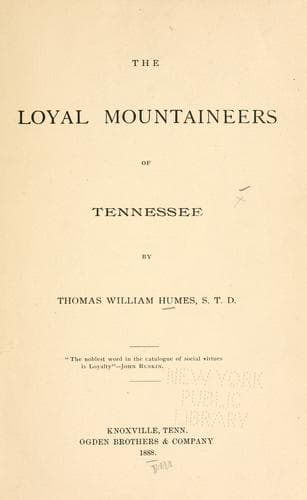
The loyal mountaineers of TennesseeHumes, Thomas William
Philosophy
The loyal mountaineers of Tennessee
Humes, Thomas William
Tennessee, East -- History -- Civil War, 1861-1865
“He was arrested at a quarterly meeting on Friday night, and
marched on foot on Saturday nine miles, being refused the
privilege of riding his own horse: and on Sabbath he was landed
at Knoxville. He is a large, fleshy man, weighs two hundred
and eighty-one pounds, and was recovering from a long spell of
fever. He gave out at a spring some seven miles from where he
started. The day was warm, and his feet were sorely blistered. He
begged permission to ride; he was refused, cursed, denounced and
threatened with bayonets! His horse was led after him as if to
aggravate him. They even refused him water to drink or anything
to eat until Sunday.”
He is represented in the same editorial to have had “the confidence
of men of other denominations.”
That he was “a very poor man, with a wife and six helpless children”
could have availed him nothing had he been guilty, but the absence
of all evidence that he had done anything for which he should be
punished, induced his discharge after three days custody in camp,
“without entering into bonds or taking any oath.”
Some of the Union men arraigned before Judge Humphreys were
temporarily imprisoned. It was not, however, until his departure from
the scene and after the bridge-burnings, that more severe measures
were adopted against that class of citizens.
Commissioner Robert B. Reynolds presided over these stringent
proceedings at first and for some time. He was a native Tennesseean,
had “the courage of his opinions” and had been conspicuous as one
of the few and faithful, who at the home of Hugh Lawson White,
adhered to Martin Van Buren as Andrew Jackson’s lineal successor.
Afterwards he was a Paymaster in the United States Army. Probably
his appointment to the office of Confederate States Commissioner was
more due to two of his qualifications than to anything else. These
were, his great zeal for “the South,” according to a current phrase,
“in its contest for its rights,” and his understood inflexibility of
will. There were members of the Bar who thought his knowledge of the
Law to be deficient, and his adversaries attributed brusqeness and
austerity to his judicial manner. On the other hand, his political
friends commended his performance of duty to the Government he served
with such full and ardent sympathy. No one could complain of him for
want of diligence and energy as a worker.
Public-domain text, read in full here on John Shaqi.
Reviews
Reviews
No reviews yet
Be the first to share your thoughts on this work.
Elsewhere in the archive
Join the Discussion
Join the discussion
Sign in to leave a comment or review.
Sign InorCreate an account