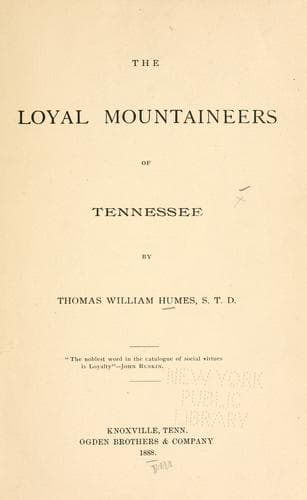
The loyal mountaineers of TennesseeHumes, Thomas William
Philosophy
The loyal mountaineers of Tennessee
Humes, Thomas William
Tennessee, East -- History -- Civil War, 1861-1865
For a considerable time, including that in which these trials,
imprisonments and executions occurred, there was a reign of terror
over Union people. The vigilance of the party in power subjected
even citizens of better social position to arraignment for slight
or insufficient reasons. To have been born in a Northern State
was _prima facie_ a ground of suspicion, unless the person were
a pronounced friend of the rebellion. Equally so was the fact
that one had been a conspicuous Unionist before the secession of
Tennessee, more especially if his position in reference to public
affairs generally, was prominent. Dr. R. H. Hodsden, of Sevier, and
Representative of that county and Knox, was hunted for, but evaded
the search until he was induced to believe that he would not
be harshly treated. He then surrendered himself to his pursuers,
and upon giving security for his good conduct and declaring his
submission to the Confederate Government, he was released from
custody. Col. Connelly F. Trigg, chairman of the chief committee in
the Union Convention at Knoxville and Greeneville, of May and June,
feared with good reason that he would be arrested. He therefore made
his escape speedily but with difficulty through the mountains into
Kentucky. Other lawyers, known to have been friends of the Union,
were admitted to the practice of their profession before Judge
Humphreys, upon their submission to the Confederate Government.
[Illustration: HON. C. F. TRIGG.]
During this time, General Zolicoffer, whose camp was on the
Kentucky border, made a visit to Knoxville, and by his direction,
as it was understood, the soldiers who guarded the town and also
the requirement of an oath of allegiance for ingress and egress,
were withdrawn. The general condition of things, however, was so
disturbing and offensive to Union men throughout East Tennessee
that their departure from the country became more frequent. Among
their leaders who had not yet gone away, the person most obnoxious
to the Confederate authorities was the Rev. Wm. G. Brownlow. He had
been from the beginning of their _de facto_ government in the State
a thorn in their flesh. Through his weekly journal, the _Whig_, he
had annoyed them with complaints of acts of oppression and violence,
and a bold use of the freedom of the press, which left no room for
doubt of his loyalty at heart to the United States, yet gave no
occasion for his arrest and punishment. These ills threatened him
so strongly about the middle of October, that he felt compelled to
suspend the publication of his newspaper. In the number issued on
the 21st of that month, he informed its readers of the indictment
impending over him before the grand jury of the Confederate court at
Nashville, and that he could probably “go free by taking the oath”
which the authorities were “administering to other Union men,” but
his “settled purpose” was “not to do any such thing.” He spoke of
“the wanton outrages upon right and liberty” suffered by the people
Public-domain text, read in full here on John Shaqi.
Reviews
Reviews
No reviews yet
Be the first to share your thoughts on this work.
Elsewhere in the archive
Join the Discussion
Join the discussion
Sign in to leave a comment or review.
Sign InorCreate an account