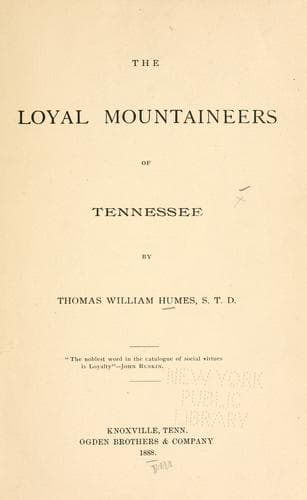
The loyal mountaineers of TennesseeHumes, Thomas William
Philosophy
The loyal mountaineers of Tennessee
Humes, Thomas William
Tennessee, East -- History -- Civil War, 1861-1865
On the 20th of January, 1862, the battle of Fishing Creek, or Mill’s
Springs, Kentucky, was fought and the victory won by General Thomas,
of the United States army, produced a strong, disturbing sensation
among the Confederates at Knoxville. For this there were good
reasons. The battle-field was not far distant; it was the first fight
of any importance that was at all near the town; the Confederate
chief Zolicoffer and his subordinate Generals, Crittenden and
Carroll, had been successively in command at Knoxville, and many of
their troops had been stationed there at different times. Upon their
defeat, they went according to the rule with Buonaparte’s soldiers
upon their defeat at Waterloo: _sauve qui peut_; and some of them in
the pell-mell flight were not slow in reaching Knoxville. The tidings
they carried created intense excitement, anger and fear. At first the
blame of the defeat was attributed chiefly to Gen. Crittenden and his
inferior in office, Gen. Carroll, both of whom, it was alleged, were
drunk on the eve of the occasion. The story ran, that Zolicoffer,
who was slain in the fight, had opposed the attack upon the Federal
army, and that being over-ruled, he had entered on it reluctantly.
All the reproaches visited upon Crittenden and Carroll grew out of,
or were plausibly justified by, their reputation for using spirituous
liquors to excess. When the agitation subsided, the Fishing Creek
tales were found to be untrue. Gen. Crittenden, from being cursed as
an inebriate and almost suspected as a traitor, became an object of
friendly sympathy as a victim of ill luck in war. Popular opinion
is always capricious and prone to undue elation or depression in
prosperous or adverse circumstances. The wrath to which calamities
move the thoughtless and passionate must be vented upon somebody,
and it is apt to turn upon him through whose well known frailty the
calamity may easily have been incurred. The intemperate man has to
suffer for a time at least, on occasions of ill to which he is a
party, from the quick presumption in people’s minds that his vicious
indulgence stands as an open door to all blunder and disaster.
Public-domain text, read in full here on John Shaqi.
Reviews
Reviews
No reviews yet
Be the first to share your thoughts on this work.
Elsewhere in the archive
Join the Discussion
Join the discussion
Sign in to leave a comment or review.
Sign InorCreate an account