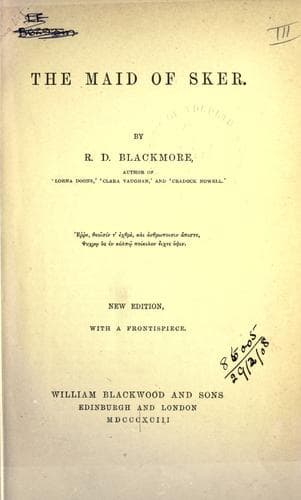
The Maid of SkerBlackmore, R. D. (Richard Doddridge)
General
The Maid of Sker
Blackmore, R. D. (Richard Doddridge)
Foundlings -- Fiction; Romance fiction; Wales -- Fiction
as if, in spite of the Creator's wisdom, I were dead and my wife alive!
CHAPTER XX.
CONFIDENTIAL INTERCOURSE.
But everybody must be tired of all this trouble about that boat. It
shows what a state of things we live in, and what a meddlesome lot we
are, that a good man cannot receive a gift straight into his hands from
Providence, which never before rewarded him, though he said his prayers
every night almost, and did his very best to cheat nobody; it proves, at
least to my mind, something very rotten somewhere, when a man of
blameless character must prove his right to what he finds. However, I
had proved my right, and cut in Colonel Lougher's woods a larger pole
than usual, because the law would guarantee me, if at all assaulted.
And truly, after all my care to be on the right side of it, such a vile
attack of law was now impending on me, that with all my study of it, and
perpetual attempts to jam its helm up almost into the very eye of
reason, my sails very nearly failed to draw, and left me shivering in
the wind. But first for what comes foremost.
At that particular moment all things seemed to be most satisfactory.
Here was my property duly secured and most useful to me, here was a run
of fish up from the Mumbles of a very superior character, here was my
own reputation spread by the vigilance of the public press, so that I
charged three farthings a-pound more than Sandy Mac did, and here was my
cottage once more all alive with the mirth of our Bunny and Bardie. To
see them playing at hide-and-seek with two chairs and a table; or
"French and English," which I taught them; or "come and visit my
grandmother;" or making a cat of the kettle-holder, with a pair of ears
and a tail to it; or giving a noble dinner-party with cockles and
oyster-shells, and buttons, and apple-peel chopped finely; or, what was
even a grander thing, eating their own dinners prettily, with their
dolls beside them,--scarcely any one would have believed that these
little ones had no mothers.
And yet they did not altogether seem to be forgetful, or to view the
world as if there were no serious side to it. Very grave discourse was
sometimes held between their bouts of play, and subjects of great depth
and wonder introduced by doll's clothes. For instance:--
"Hasn't 'a got no mama, poor Bunny, to thread 'e needle?"
"No, my dear," I answered, for my grandchild looked stupid about it;
"poor Bunny's mother is gone to heaven."
"My mama not gone to heaven. My mama come demorrow-day. I'se almost
tired of yaiting, old Davy, but she sure to come demorrow-day."
But as the brave little creature spoke, I saw that "the dust was in her
eyes." This was her own expression always, to escape the reproach of
crying, when her lonely heart was working with its misty troubles, and
sent the tears into her eyes, before the tongue could tell of them.
"Demorrow-day, demorrow-day," all her loss was to be recovered always on
"demorrow-day."
Public-domain text, read in full here on John Shaqi.
Reviews
Reviews
No reviews yet
Be the first to share your thoughts on this work.
Elsewhere in the archive
Join the Discussion
Join the discussion
Sign in to leave a comment or review.
Sign InorCreate an account