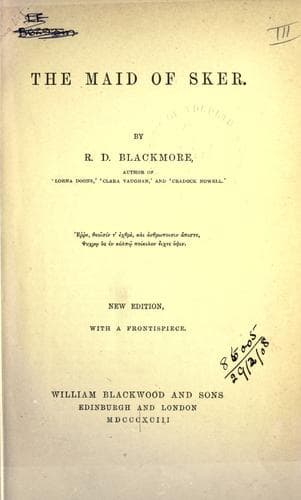
The Maid of SkerBlackmore, R. D. (Richard Doddridge)
General
The Maid of Sker
Blackmore, R. D. (Richard Doddridge)
Foundlings -- Fiction; Romance fiction; Wales -- Fiction
This honest affection impressed me not a little in his favour, and in
less than half an hour I found him a thoroughly worthy fellow: while he
perceived, through a square-stalked rummer, that my character was
congenial. I told him therefore some foreign stories, many of which were
exceedingly true, and he by this time was ready to answer almost
anything that I chose to ask, even though he knew nothing about it. As
for the people that wore no clothes, but lived all together in the old
mud-house, there need be and could be no mystery. Every one knew that
his Reverence had picked them up in his early days, and been pleased
with their simple appearance and dislike of cultivation. Perceiving even
then how glad he might be, in after-life, to annoy his neighbours, what
did he do but bring these people (then six in number, and all of them
wives and husbands to one another) and persuade them to dig themselves
out a house, and by deed of gift establish them on forty acres of their
own land, so that, as Englishmen love to say, their house was now their
castle. Not that these were perhaps English folk, but rather of a Gipsy
cross, capable, however, of becoming white if a muscular man should
scrub them. The groom said that nobody durst go near them, except Parson
Chowne and Parson Jack, and that they seemed to get worse and worse, as
they began to be persecuted by clothes-wearing people. I asked him what
their manners were; and he said he believed they were good enough, so
long as not interfered with; and who could blame them for maintaining
that whether they wore clothes or not was entirely their own concern:
also, that if outer strangers intruded, from motives of low curiosity,
upon their unclad premises, it was only fair to point out to them the
disadvantages of costume, by making it very hard to wash? There was some
sense in this, because the main anxiety of mankind is to convert one
another; and the pelting of mud is usually the beginning of such
overtures. And these fine fellows having recurred (as Parson Chowne
said) to a natural state, their very first desire would be to redeem all
fellow-creatures from the evils of civilisation. Whereof the foremost
perhaps is clothes, and the time we take in dressing--a twelfth part of
their waking life, with even the wisest women, and with the unwise
virgins, often not less than three-quarters; and with many men not much
better.--But to come back to my savages. I asked this good groom how it
came to pass that none of the sheriffs, or deputies, or even magistrates
of the shire, put down this ungoodly company. He said that they had
tried, but failed, according to the laws of England, on the best
authority. Because these men of the ancient Adam went back to the time
before the beasts had come to Adam to get their names. They brought up
their children without a name, and now all names were dying out, and
they agreed much better in consequence. And how could any writ, warrant,
Public-domain text, read in full here on John Shaqi.
Reviews
Reviews
No reviews yet
Be the first to share your thoughts on this work.
Elsewhere in the archive
Join the Discussion
Join the discussion
Sign in to leave a comment or review.
Sign InorCreate an account