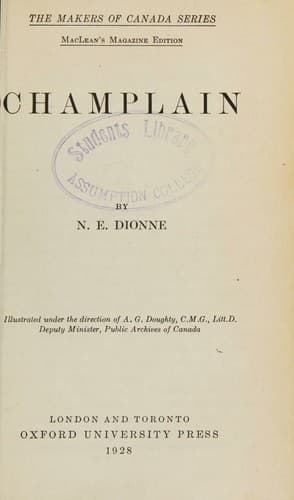
The Makers of Canada: ChamplainDionne, N.-E. (Narcisse-Eutrope)
History
The Makers of Canada: Champlain
Dionne, N.-E. (Narcisse-Eutrope)
Canada -- History -- To 1763 (New France); Champlain, Samuel de, 1574-1635
David Kirke was much dissatisfied with the agreement, which he believed
was due to the action of Sir Isaac Wake, to whom he wrote, accusing him
of not having followed the instructions of the English company. His
letter concluded with these words: "I understand that the conduct of
this affair has been absolutely irregular, as it is evident that you
have only resorted to the French testimony, having no care for the
English evidence."
In the same memorandum the Kirke family complained of the fact that the
Company of English Adventurers had been compelled to plead in France,
while the French were not subject to the same conditions. This
accusation was not correct, as Guillaume de Caen had been obliged not
only to live in London in order to vindicate his goods, but also to
watch them and prevent damage.
Kirke had no other claim than compensation for losses, and de Caen, who
had apparently no responsibility for the conflict of 1629, could not
reasonably be expected to pay the amount of Kirke's claim. The contents
of the storehouse at Quebec were the property of the de Caens, and in
visiting Quebec Emery de Caen had no other object in view than to
secure his goods and take them to France. He had nothing to do with the
war, and believed that he was sailing in times of peace. Thomas Kirke,
by whom he was taken prisoner, treated him as a pirate, illegally, and
in spite of the Treaty of Suze. It is true that the Kirkes ignored the
existence of this treaty when they sailed for America, but this was only
an excuse for their attitude as belligerents.
As soon as the provisions of the negotiations were determined upon
between the two countries, the claims had to be sent to the king, if
they considered that they had any grievance under the privileges
conferred upon them by letters of marque. The royal commission took a
correct stand in demanding from them in the name of Charles I an
indemnity for France. All these differences were at length terminated
through the energetic interference of Richelieu. These disputes had
lasted for more than two years, and constantly occupied the attention of
the ambassadors. The king of France, therefore, empowered Bullion and
Bouthillier on January 25th, 1632, to act. Charles I had already sent
Burlamachi to France with letters in favour of the restoration of Canada
and Acadia, and had also given instructions to Sir Isaac Wake, his
ambassador extraordinary. On March 5th, Louis XIII granted an audience
to the ambassadors, and the basis of a treaty was agreed upon. Sir Isaac
Wake represented Charles I, and Bullion and Bouthillier represented the
king of France.
Public-domain text, read in full here on John Shaqi.
Reviews
Reviews
No reviews yet
Be the first to share your thoughts on this work.
Elsewhere in the archive
Join the Discussion
Join the discussion
Sign in to leave a comment or review.
Sign InorCreate an account