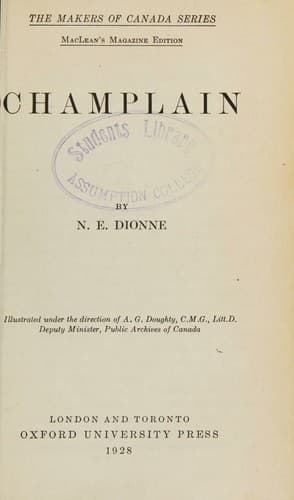
The Makers of Canada: ChamplainDionne, N.-E. (Narcisse-Eutrope)
History
The Makers of Canada: Champlain
Dionne, N.-E. (Narcisse-Eutrope)
Canada -- History -- To 1763 (New France); Champlain, Samuel de, 1574-1635
The Jesuits, who had only been in the country about four years, had not
as yet a true idea of the magnitude of the task they had undertaken.
Father Charles Lalemant had abandoned the theatre of his first apostolic
labours on our Canadian soil, at the same time that some workmen whom
Father Noyrot had brought from France during the preceding year, left
the place. He was the last representative, together with Fathers Masse,
de Nouee and de Brebeuf of the primitive church of Canada. Mention has
been made of the temporary residence in the convent of the Recollets,
and of a building which was erected for themselves at about two hundred
feet from the shore, near the junction of the river Lairet and the river
St. Charles. The Jesuits received a concession of this land which was
bounded on the west by a stream called St. Michel, and the river St.
Mary or Beauport on the east. This was named the Seigniory of Notre Dame
des Anges.
The Jesuits' convent was finished on April 6th, 1626. It was a poor
residence of about forty feet in length and thirty feet in width. The
building contained a small chapel dedicated to Notre Dame des Anges, on
account of a picture which decorated a wall representing the Blessed
Virgin receiving the homage of angels. This name extended beyond the
chapel, and was given to the seigniory, and after a lapse of three
centuries, it remains unchanged.
The different mission-stations of the Jesuits in Canada and around the
gulf of the St. Lawrence were maintained at the expense of the Hundred
Associates from the year 1632, with the exception of their college at
Quebec which was founded through the liberality of the Marquis de
Gamache, who gave them a sum of sixteen thousand ecus d'or for that
purpose, in 1626, on the occasion of his son taking religious vows. The
offer was accepted by Father Vitelleschi, general of the order, and the
college was founded in 1635, and opened a few years later. "This,"
writes Parkman, "was the cradle of the great missions of Canada!"
As soon as the Jesuits arrived they commenced to repair their residence,
and in the year 1632 it was in a fit state for a banquet which was given
to Emery de Caen, who had been appointed governor _ad interim_ of the
French colony.
Champlain returned from France to Quebec in the month of June of the
following year, and again took over the government of New France. He
brought with him Fathers Masse and Jean de Brebeuf, and their arrival
was the dawn of a brighter era for the Canadian missions. The Jesuits
founded, during the same year, a mission at Three Rivers, and another at
Ihonatiria in the Huron country. The mission-stations at Miscou and at
Cape Breton were also opened at about the same time, but they were all,
practically speaking, dependent upon the liberality of the Hundred
Associates.
Public-domain text, read in full here on John Shaqi.
Reviews
Reviews
No reviews yet
Be the first to share your thoughts on this work.
Elsewhere in the archive
Join the Discussion
Join the discussion
Sign in to leave a comment or review.
Sign InorCreate an account