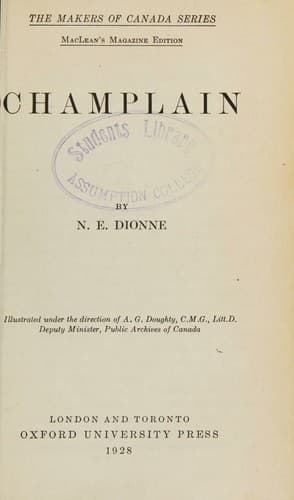
The Makers of Canada: ChamplainDionne, N.-E. (Narcisse-Eutrope)
History
The Makers of Canada: Champlain
Dionne, N.-E. (Narcisse-Eutrope)
Canada -- History -- To 1763 (New France); Champlain, Samuel de, 1574-1635
Father Perrault resided at Cape Breton during the years 1634 and 1635,
and Fathers Richard and d'Endemare came in the following year and took
up their residence at Fort Ste. Anne in Grand Cibou Bay. This place had
many advantages, as it was naturally fortified, and three thousand small
vessels could anchor safely in the bay. The Jesuits remained at Cape
Breton until the arrival of Bishop de Laval in 1659. These various
missions which we have recorded, constitute the religious history of the
islands and coasts of the gulf of St. Lawrence during the greater part
of the seventeenth century, and they were all founded by Champlain or
under his administration, and he certainly took an active part in the
civilization of the Micmacs.
In a memorandum addressed to the king, Champlain had set forth his
intention to erect a church at Quebec, to be dedicated to the Redeemer.
He was, however, unable to accomplish his design. He had also made a
solemn promise to the Blessed Virgin, between the years 1629 and 1632,
to erect a church in honour of Notre Dame de la Recouvrance, and on his
return to Quebec he set out to fulfil his obligation. The occasion was
favourable, as the chapel near the habitation in Lower Town had been
completely ruined.
The chapel of Notre Dame de la Recouvrance was erected during the summer
of 1633, and in the autumn of the same year the Jesuits said mass for
the inhabitants within the building. The increase of the population and
of their religious zeal within the two following years, induced
Champlain to raise this humble chapel into a small church. The building
was therefore enlarged, and from that date the services assumed a
character of solemnity which had been unknown before. Grand mass was
celebrated every Sunday by a Jesuit, and the inhabitants each in turn
offered consecrated loaves. In the afternoon, after vespers, the
catechism was explained by the fathers. The French were very regular in
their attendance at these ceremonies, and also at the religious
instructions.
Public-domain text, read in full here on John Shaqi.
Reviews
Reviews
No reviews yet
Be the first to share your thoughts on this work.
Elsewhere in the archive
Join the Discussion
Join the discussion
Sign in to leave a comment or review.
Sign InorCreate an account