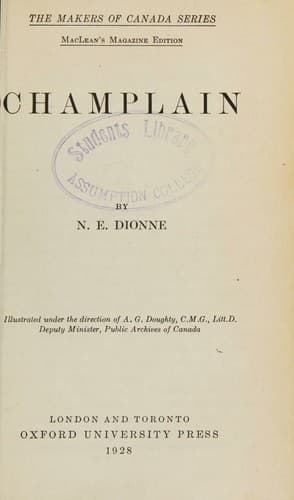
The Makers of Canada: ChamplainDionne, N.-E. (Narcisse-Eutrope)
History
The Makers of Canada: Champlain
Dionne, N.-E. (Narcisse-Eutrope)
Canada -- History -- To 1763 (New France); Champlain, Samuel de, 1574-1635
Giffard had suffered many losses, and as a compensation for his services
and misfortune, he obtained a tract of land from the Company of New
France, one league in length and a league and a half in breadth,
situated between the rivers Montmorency and Beauport, bounded in front
by the river St. Lawrence, and in the rear by the Laurentian Mountains.
He was also granted as a special favour, a tract of land of two acres in
extent, situated near the fort, for the purpose of building a residence,
surrounded with grounds. These concessions, which seem large at first
sight, were, however, not new to the colony. Louis Hebert had been
granted the fief of the Sault au Matelot, and the fief Lepinay, while
the Jesuits had received the fief of Notre Dame des Anges almost free of
conditions.
Under these favourable conditions Giffard induced two citizens of
Mortagne, Zacharie Cloutier and Jean Guyon, to accompany him to Canada.
Cloutier was a joiner, and Guyon a mason. They promised their seignior
that they would build him a residence, thirty feet long and sixteen feet
wide.
The other emigrants came to Canada at their own risk. The party numbered
forty-three persons, including women and children, and were within a
space of from five to eight leagues of Mortagne, the chief town of the
old province of Perche. There were two exceptions, however, Jean
Juchereau came from La Ferte Vidame in Thimerais, and Noel Langlois was
from St. Leonard, in Normandy.
The vessels bearing the contingent of settlers arrived in Quebec in
June. They were four in number, under the command of Captains de Nesle,
de Lormel, Bontemps, and Duplessis-Bochart. Robert Giffard had preceded
the party by a few days, and he lost no time in selecting the spot where
his residence was to be built, upon which he planted a cross on July
25th. He also commenced clearing the land, and two years after he
gathered in a harvest of wheat sufficient to maintain twenty persons.
The soil in this part was very productive, and it is, even to-day, the
richest in the province of Quebec.
Among the emigrants of the year 1634 were two remarkable men, Jean
Bourdon, and a priest named Jean LeSueur de St. Sauveur. The Abbe
LeSueur de St. Sauveur had abandoned his parish of St. Sauveur de
Thury, which is to-day known as Thury-Harcourt, in Normandy, to come to
Quebec. One of the suburbs of Quebec to-day takes its name from this
active and devoted priest.
Jean Bourdon, an inseparable friend of the abbe, established himself on
the borders of Coteau Ste. Genevieve, which is to-day known as St.
John's suburb. He built a house and a mill, and also a chapel, which he
named Chapel St. Jean. Other pioneers soon settled near Bourdon's place,
which finally gave to Quebec a suburb.
Public-domain text, read in full here on John Shaqi.
Reviews
Reviews
No reviews yet
Be the first to share your thoughts on this work.
Elsewhere in the archive
Join the Discussion
Join the discussion
Sign in to leave a comment or review.
Sign InorCreate an account