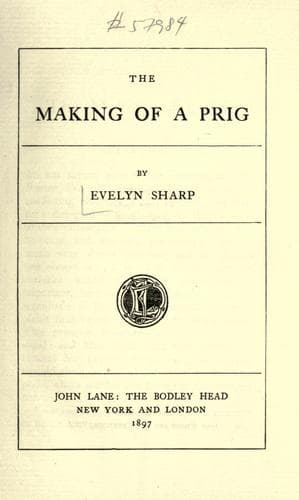
England -- Social life and customs -- 19th century -- Fiction
He still believed in her, then; only it was more from habit than
conviction. But she had destroyed his love for her. She realised these
two facts in the same breath, and she rebelled passionately at the
loss of the affection that had been hers for so long, though she had
valued it so lightly.
"I do want you, now," she scribbled to him in pencil. "Will you come
here to-morrow evening? Miss Jennings has promised me the use of her
sitting-room. I shall expect you about seven."
It seemed quite in harmony with the general wretchedness of those few
days that Phyllis should be seriously ill all the time. The
sixty-three working gentlewomen, who had never pretended to care for
the brusque shorthand clerk when she was in good health and trampled
without a scruple on their tenderest susceptibilities, now went about
on tiptoe, and conversed in whispers on all the landings, and got in
the way of the doctor when he came downstairs. And they one and all
condemned Katharine for her indifference, because she refused to
enlarge on the subject at every meal.
"The conversation is never very exhilarating, at the best of times;
but when all those women take to gloating over a tragedy, it simply
isn't bearable," she was heard to exclaim; and the unlucky remark cost
her the last shred of her popularity at Queen's Crescent.
She was waiting at her usual post on the stairs, when they came to
tell her that Ted was downstairs. He had come at her bidding; that
was consoling, at all events. But when she walked into Miss Jennings'
private room and saw his face as he stood on the hearthrug, her heart
sank again, and she knew that she was not to find consolation yet. He
held out his hand to her silently, and pulled forward a slender,
white-wood chair tied up with yellow ribbons, and imperilled a bamboo
screen crowded with cheap crockery, and finally sat down himself on
the edge of the chintz-covered sofa. Neither of them spoke for a
moment or two, and Ted cleared his throat uncomfortably, and stared at
the ferrule of his walking-stick.
"I got your letter," he said at last, "and I've come."
"Yes," said Katharine, "you've come."
Having delivered themselves of these two very obvious remarks, they
again relapsed into silence; and Katharine glanced at the cuckoo
clock, and marvelled that so much concentrated wretchedness could be
crowded into something under five minutes.
"Ted," she forced herself to say, in a voice that did not seem to be
hers, "Ted, will you never come and see me any more?"
He lifted his head and looked at her; then looked away again.
"Not unless you want me to do anything for you," he said. "I don't
want to bother, you see."
Public-domain text, read in full here on John Shaqi.
Reviews
Reviews
No reviews yet
Be the first to share your thoughts on this work.
Elsewhere in the archive
Join the Discussion
Join the discussion
Sign in to leave a comment or review.
Sign InorCreate an account